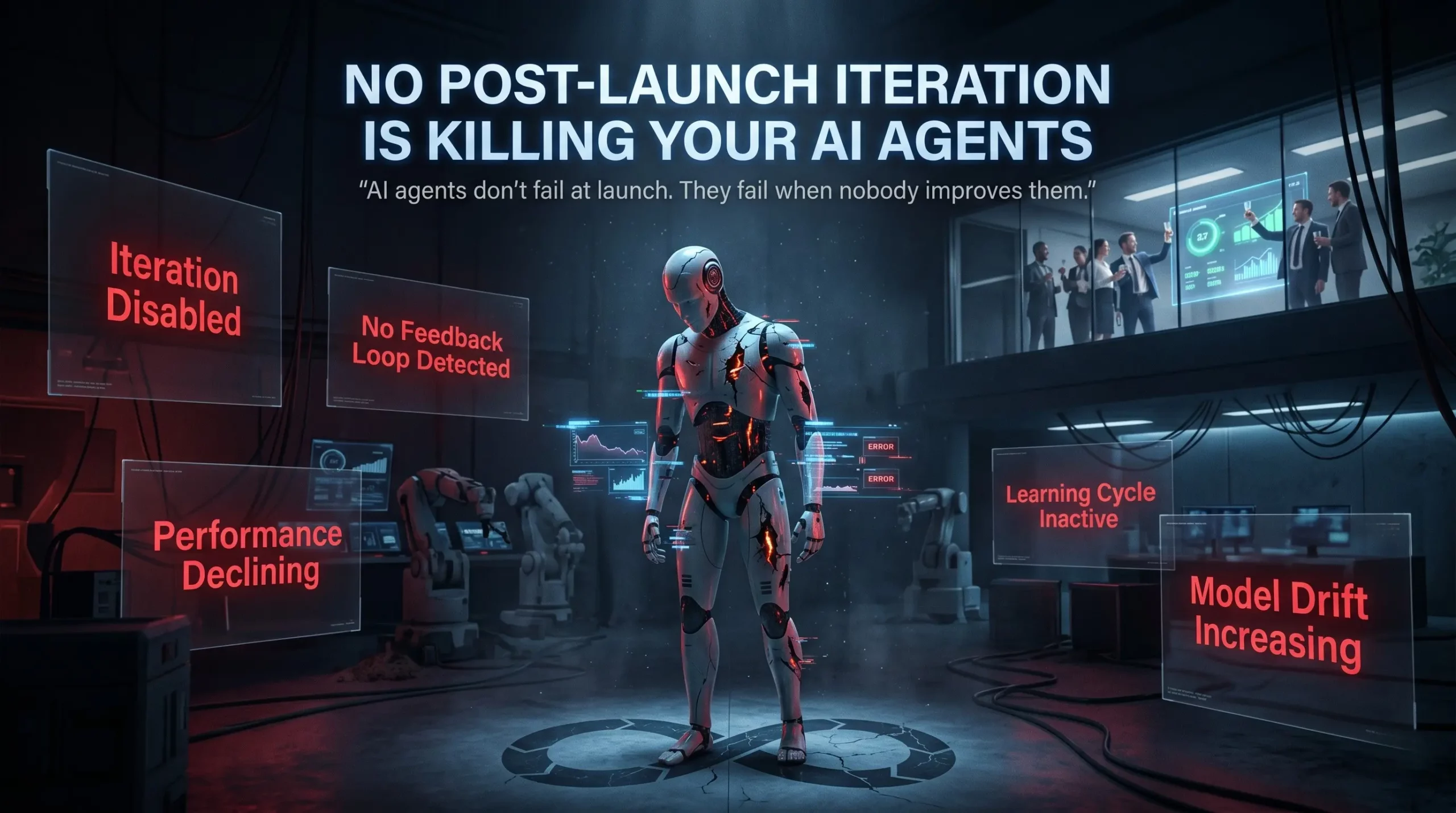
You spent months building your AI agent. The demo worked beautifully. Leadership approved the rollout. And then you launched. That was six months ago. Here is the question nobody in your organization is asking: is that agent actually getting better?
Most of the time, the honest answer is no. Not because the technology failed, but because the team moved on. There is a deeply ingrained assumption in enterprise AI deployments that launch is the finish line. It is not. Launch is where the real work begins. And skipping the post-launch iteration phase is one of the most expensive mistakes organizations make with AI agents today.
This is part of a broader pattern we have been tracking across enterprise AI readiness. If you have already read about how scattered knowledge silently sabotages your AI agents, you will recognize the theme: the problems that kill AI agent performance are rarely about the model itself. They are, instead, about the organizational infrastructure around it. And no post-launch iteration is one of the most overlooked gaps of all.
The Production Reality
The Composio AI Agent Report 2025 found that 67% of organizations report measurable gains from agent pilots, yet only 10% successfully scale to production. The gap does not sit in the technology. It lives, instead, in what happens, or more accurately what does not happen, after the agent goes live.
Let us be clear about what we are talking about. Post-launch iteration for AI agents is the ongoing process of monitoring real-world performance, collecting feedback, identifying failure patterns, and making targeted improvements. In other words, it is the cycle that turns a static deployment into a system that learns and compounds value over time.
Without it, your AI agent becomes frozen at the capability level it had on launch day. That is a serious problem, because the world around it does not stay frozen. Business processes shift, data patterns change, user needs evolve, and edge cases multiply. As a result, what performed well in testing starts encountering situations it was never prepared for in production.
The degradation is rarely dramatic, which is precisely what makes it so dangerous. A real-world case documented by SaaStr describes a team that deployed an AI agent, watched it perform well, and then moved on to other projects. Four months later, the agent had quietly stopped ingesting new data. Moreover, it kept running and kept producing outputs that looked plausible, but was operating entirely on stale information. The team only caught it when results started feeling slightly off. Not wrong enough to trigger alarms. Just a little out of step with reality.
This is the operational signature of an AI agent with no iteration loop. Rather than crashing visibly, it just slowly stops being useful.
Furthermore, the same dynamic is explored in depth in our LinkedIn article on why post-launch iteration is the silent reason your AI agents underperform, which looks at how this pattern shows up across enterprise deployments of every size.
The scale of the problem is becoming impossible to ignore. According to a June 2025 Gartner press release, over 40% of agentic AI projects will be canceled by the end of 2027, with escalating costs, unclear business value, and inadequate risk controls as the primary reasons. What does inadequate risk control look like in practice? Often it looks exactly like an agent running in production with no feedback loop and no mechanism for improvement.
McKinsey’s 2025 State of AI report reinforces the picture: fewer than 20% of AI pilots scale to production within 18 months, and only 39% of organizations report any enterprise-level EBIT impact from AI. Consequently, the organizations that are generating real returns are not necessarily the ones with the best models. They are the ones that have built processes for continuous improvement after launch.
Beyond that, research from Lemma, a YCombinator F25 company building continuous learning infrastructure for AI agents, found that agent performance can drop approximately 40% within weeks of deployment. This happens as real-world input drift introduces user behaviors and edge cases that were not present in testing. That is not a model failure. That is a process failure, and it is entirely preventable with the right iteration infrastructure in place.
The Compounding Cost
High-volume agents processing thousands of transactions daily see measurable accuracy improvements within 30 to 45 days when a feedback loop is active. Without one, however, performance flatlines or silently degrades from day one. The longer you wait to implement iteration, the more ground you have to recover.
Understanding the specific mechanisms of performance stagnation helps you make the case internally for why iteration infrastructure is not optional. Here are the five most common patterns we see.
Your agent was trained and tested on a specific snapshot of your business data. The moment it goes live, however, the real world starts diverging from that snapshot. New product lines, updated workflows, seasonal demand shifts, and new customer segments all push the agent away from its original frame of reference. Distribution shift is the technical term for this divergence, and without continuous monitoring, it remains invisible until the agent starts making decisions that feel wrong but are hard to explain.
The connection to your broader data environment is critical here. If your organization already struggles with multiple versions of truth creating conflicting data across systems, distribution shift compounds that problem at speed.
No pre-launch test suite captures every real-world scenario. Edge cases are inevitable, and therefore the question is not whether your agent will encounter them but whether your organization has a mechanism for identifying, analyzing, and resolving them. Without an iteration process, those edge cases pile up and are never addressed. Each one represents a user who received a wrong or unhelpful response. At scale, this erodes trust in ways that are very difficult to recover from.
Organizations are not static. Processes change, policies update, and teams restructure constantly. As a result, an AI agent trained on how your business operated six months ago becomes increasingly misaligned with how it operates today. This is especially dangerous when the agent is handling workflows that touch customers, finance, or compliance. We have covered the upstream version of this problem in our piece on undocumented workflows and AI automation failures. The same dynamic plays out post-launch when iteration is absent.
Research from Dust’s continuous improvement framework is clear on this point: if there is no clear owner for an agent and no time allocated to iterate, agents simply do not improve. Feedback that is never collected cannot drive learning. In addition, many organizations have no structured process for gathering input from the people who interact with the agent every day, whether they are employees or customers.
Because of this, organizations that have no system for measuring AI agent performance after deployment are essentially operating blind. You cannot improve what you are not measuring.
An agent that handled sensitive data appropriately at launch may not remain compliant as regulations evolve and your data environment changes. Security models built for static systems need regular review when applied to autonomous agents. This is not theoretical: the AI Incidents Database reports that AI-related incidents rose 21% from 2024 to 2025. Furthermore, many of those incidents involve agents that were operating outside their original governance parameters without anyone noticing.
For a detailed look at why security frameworks designed for human operators fail AI agents, our blog post on security models built only for humans creating AI agent vulnerabilities covers the specific gaps that post-launch monitoring needs to close.
Here is the thing: building an iteration loop for your AI agent does not require a separate engineering team or a six-month project. It requires clarity about four things.
You need a system that scores agent responses against accuracy, helpfulness, and task completion on an ongoing basis, not just in pre-launch testing. Leading evaluation frameworks now support LLM-as-a-judge scoring, where a secondary model reviews a sample of production outputs and generates quality scores. Performance is graphed over time, and alerts fire when quality degrades. As a result, you find out from a dashboard rather than from an angry user or a manager who noticed something felt off.
The people using your agent every day are your best source of iteration signal. Building a lightweight, structured mechanism for them to flag unhelpful or incorrect responses turns anecdotal frustration into actionable data. Fortunately, the feedback does not need to be complex. A simple thumbs-down with a category tag is enough to surface patterns.
Beyond flagging errors, your approval and review layer for AI outputs becomes a source of iteration data, not just a quality gate. Every human review generates a signal about where the agent’s judgment diverged from the expected outcome.
The most common mistake in post-launch iteration is trying to overhaul the agent when a targeted edit would suffice. The Dust framework recommends starting with the top failure mode surfaced by your monitoring, making a surgical change to instructions, data sources, or parameters, testing with a small group, and then rolling out broadly. Small, targeted changes are easier to test and, equally important, easier to roll back if something breaks.
This is the iteration mentality that software engineering teams have applied for decades. AI agents deserve the same discipline. Ship, measure, learn, and improve. Then repeat.
No iteration loop survives without a named owner. Someone in your organization needs to be responsible for the agent’s ongoing performance, with time explicitly allocated to the iteration process. Without this structure, feedback goes nowhere and insights gather dust. This gap is directly linked to the leadership ownership gap that keeps AI agents underperforming across enterprises, a pattern our piece on leadership not driving AI adoption examines from the top down.
Let us paint the picture honestly. Six months after launch, an AI agent with no iteration process typically looks like this:
This is not a hypothetical. It is the operational reality for a significant portion of enterprise AI deployments today. The Composio 2025 report’s finding that only 10% of organizations successfully scale agent pilots to production reflects both a pre-launch problem and a post-launch one. Many organizations reach production and then fail to sustain it because there is no iteration infrastructure keeping the agent aligned with reality.
The data quality dimension makes this even more acute. If your agent is operating on real-time data access gaps that leave it working from outdated information, the absence of post-launch iteration means those gaps compound rather than get resolved. Consequently, the agent becomes increasingly disconnected from the current state of your business.
If you are a technology leader reading this, you likely already know the iteration gap exists in your organization. The challenge, however, is making the case for dedicated iteration resources in an environment where the initial deployment already consumed significant budget and attention.
Here is the framing that tends to land with business stakeholders. Your AI agent is a revenue or efficiency-linked system. Its current performance level represents a baseline, and therefore every week you do not iterate is a week you are leaving potential improvement on the table. Every edge case that accumulates represents a customer interaction or process step where the agent is actively failing. The cost of not iterating is not zero. It is the cumulative sum of all those missed improvements and unresolved failures.
McKinsey data shows that organizations achieving real ROI from AI are not necessarily using better models. Instead, they are applying better operational discipline to the systems they have. The 5.8x ROI on AI investment within 14 months that McKinsey’s research documents is not achieved by deploying and forgetting. It is achieved by deploying, measuring, iterating, and compounding gains over time.
Beyond the commercial case, the technical teams building documentation for your agent also need to be part of this discussion. If your documentation does not reflect how AI agents actually make decisions in the field, iteration becomes much harder because you have no reliable baseline to measure against.
You do not need to wait for a perfect system. You need to start. Here is a practical sequence that works for organizations at every stage of AI maturity.
Name a single person responsible for the ongoing performance of each production AI agent. While this does not need to be a full-time role, it needs to be a named accountability. Without ownership, everything else in this list will fail to stick.
Before you can track improvement, you need to know where you are starting. Pull your current task completion rates, user satisfaction signals, and error patterns. If you do not have this data yet, the first iteration sprint should focus on instrumentation: getting the logging and monitoring in place so you have something to measure against.
Set a recurring thirty-minute review where the agent owner looks at the feedback and error data from the previous week. Identify the top failure pattern. Then make one targeted improvement, not a full rebuild. Test it, observe the impact, and repeat next week.
The iteration process only works if the agent is operating on accurate, current data. If scattered knowledge across your organization is limiting what your AI agents can access, your iteration loop needs to include data quality improvements, not just prompt tuning.
Finally, post-launch iteration should not be an informal practice that depends on individual initiative. It should be a documented process with scheduled reviews, defined metrics, and governance sign-off for significant changes. This is what turns a good AI deployment into a sustainable one.
Here is a perspective shift worth sitting with. Every enterprise software system your organization depends on gets maintained, updated, and improved on a regular cycle. Nobody deploys a CRM or an ERP and then never touches it again. Yet that is exactly the treatment many organizations give their AI agents, and then they wonder why the results plateau.
AI agents are not set-and-forget tools. They are living systems that operate in changing environments and need ongoing attention to stay aligned with your business reality. Therefore, the organizations that will generate lasting ROI from AI are the ones building the discipline of continuous iteration into their deployment model from day one.
Gartner’s warning that over 40% of agentic AI projects will be canceled by end of 2027 is not a verdict on AI technology. Rather, it is a verdict on AI deployment practices. The technology works. The processes around it are, however, still catching up. Post-launch iteration is one of the places where closing that gap makes the most immediate difference.
If you are building AI agents at scale and want to make sure iteration is built into your readiness model from the ground up, connect with the Ysquare Technology team on LinkedIn to explore how we approach enterprise AI agent deployment with long-term performance in mind.
How can you supercharge your business with bespoke solutions and products.