

Here is a question worth sitting with: Your company just spent six figures on AI tools. Your IT team built the pilots. Your vendor gave three onboarding sessions. And yet, six months in, adoption across the organization is hovering somewhere between “low” and “invisible.”
Sound familiar?
This is not a technology problem. It is not a budget problem. And it is definitely not a problem your IT team can fix on their own.
When leadership isn’t driving AI adoption, everything else you do to push it forward is just noise. Teams take their cues from the top. If they don’t see their managers, directors, and executives actively using AI, talking about AI, and holding people accountable to AI outcomes, then AI becomes just another initiative that will quietly fade away after the next quarterly review.
The data backs this up. McKinsey’s 2025 Workplace AI report surveyed 3,613 employees and 238 C-level executives and found that employees are ready for AI, but leaders are not steering fast enough. The biggest barrier to success is leadership.
That is not a small finding. That is the finding. And if you’re a CEO, CTO, or senior business leader, this one is squarely on your desk.
Most organizations frame AI adoption as a rollout problem. They build a roadmap, pick a vendor, set up training sessions, and wait for adoption to happen. It doesn’t. Because adoption isn’t a rollout problem. It’s a culture problem, and culture is set by leaders.
Think about how any new behavior spreads inside a company. People don’t change how they work because they attended a webinar. They change because they see their peers doing things differently, because their manager asks them different questions, and because their performance is measured against different outcomes. None of that happens without leadership actively driving it.
When executives treat AI as someone else’s responsibility, a few predictable things occur. Teams see AI as optional. Middle managers don’t prioritize it. Budgets get questioned at renewal time. And the early adopters who were genuinely excited burn out trying to evangelize uphill without any support.
McKinsey’s research shows that AI high performers are three times more likely to have senior leaders who demonstrate ownership of and commitment to their AI initiatives. Those same leaders actively use AI themselves and role-model the behavior they want to see across the organization.
That three-times multiplier isn’t marginal. It’s the difference between companies that are genuinely transforming and companies that are running expensive pilots forever.

The statistics here are sobering, and leaders need to face them honestly.
According to McKinsey’s 2025 State of AI report, 88% of organizations reported regular AI use in at least one business function in 2025, compared with 78% a year earlier. But only about one-third have begun scaling AI programs across the organization. The gap between “we’re using AI somewhere” and “AI is changing how we operate” is enormous, and leadership behavior sits right in the middle of it.
A 2025 report from WRITER, which surveyed 1,600 knowledge workers including 800 C-suite executives, found that more than one in three executives describe their generative AI adoption as a “massive disappointment.” Two-thirds of C-suite leaders reported tension between IT teams and other business units around AI implementation.
Here’s the number that should alarm every board room: Only 28% of organizations report that their CEO takes direct responsibility for AI governance and oversight. Yet the companies where the CEO is directly involved in AI governance report meaningfully higher business impact from their AI investments.
The math is simple. When the CEO owns it, it gets resourced, prioritized, and measured. When AI is delegated to a single team, it gets stuck.
McKinsey’s March 2025 report, “How Organizations Are Rewiring to Capture Value,” reinforces this directly: only 28% of respondents whose organizations use AI say their CEO oversees AI governance, and CEO oversight is strongly correlated with higher self-reported bottom-line impact.
No case study on AI adoption failure is more instructive than the story of IBM Watson for Oncology.
IBM positioned Watson Health as a moonshot. The technology would democratize elite oncology expertise, helping clinicians around the world make better cancer treatment decisions. IBM committed billions of dollars. The marketing was confident. The promise was enormous.
What actually happened was a governance and leadership failure at scale.
The system was developed with training data curated by a small group of physicians using hypothetical patient cases, not real clinical data. When hospitals tried to deploy it in the real world, the recommendations were often inconsistent with national treatment guidelines. One physician at a Florida hospital told IBM executives the system was “worthless” for most cases, and that the hospital had bought it largely for marketing purposes.
When MD Anderson Cancer Center, one of Watson’s most prominent partners, transitioned from its legacy EHR system to Epic Systems, Watson couldn’t access live patient data. A $62 million investment became, in the words of one review, a “custom demo.”
By 2022, IBM announced the sale of Watson Health’s healthcare data and analytics assets to Francisco Partners. Financial terms were not officially disclosed, though reports placed the deal at more than $1 billion, a figure widely understood to represent a fraction of the total capital invested in acquisitions, development, and deployment across the life of the program.
The core failure wasn’t the technology itself. As researchers and analysts have since noted, the problem was structural and organizational. IBM’s leadership scaled the product before the conditions for it to work were established. There was no rigorous governance to catch the gap between what was being promised externally and what was actually possible internally. Clinical experts weren’t embedded deeply enough. The business case was built on narrative rather than evidence.
This is precisely what happens when AI adoption is treated as a product launch rather than as an organization-wide capability change that requires sustained leadership ownership at every level.
Source: Henrico Dolfing Case Study Analysis, December 2024
The answer to “leadership isn’t driving AI adoption” isn’t to send another memo or mandate a new tool. It is to change behavior, specifically leadership behavior, in visible and consistent ways.
Here’s what that looks like in practice.
Use the tools publicly. When a CEO shares that they used AI to prepare for a board meeting, or a VP mentions in a team call that they ran a prompt to summarize competitive research, those small moments signal that AI is real, not aspirational. Visibility matters enormously.
Ask AI-related questions in reviews. If the only metrics being reviewed are the same ones from two years ago, nothing changes. Leaders who ask “how did we use AI to get this result?” or “where did AI save us time this quarter?” are reshaping what the team pays attention to.
Assign explicit ownership. Not a committee. Not a shared responsibility. One named person whose job includes making AI adoption work, with a budget, a timeline, and reporting lines directly into leadership. As our analysis of why leadership must drive AI agent adoption shows, the moment there is no single owner, accountability evaporates.
Remove the barriers teams face. Most frontline employees aren’t anti-AI. They’re time-poor, risk-averse, and waiting for permission. Leaders need to create psychological safety around experimentation, reduce the bureaucratic friction around tool access, and make it easy to try things without fear of looking incompetent.
Tie AI outcomes to performance conversations. What gets measured gets done. When teams know that AI capability building is part of how they are evaluated, they prioritize it.
Leadership behavior is only one part of the equation. Even the most committed executive can’t drive adoption if the organization’s infrastructure isn’t ready for AI agents to work.
This is a critical point that gets skipped in most leadership conversations about AI.
Your AI agents are only as reliable as the data and systems they operate in. If knowledge is scattered across tools and teams, agents won’t find what they need. We cover this challenge in depth in our piece on why scattered knowledge is silently sabotaging your AI, and in our blog on scattered knowledge and AI agent readiness.
If your documented processes don’t reflect how work actually happens, agents will make decisions based on outdated or wrong information. This is explored in our piece on what happens when your documentation lies, and in our undocumented workflows blog.
If different teams are working from different versions of the same data, the conflict kills AI decision quality before it even starts. Our article on multiple versions of truth and why conflicting data kills your AI makes this concrete, and our blog on multiple versions of truth walks through the fix.
If agents can’t access real-time data, every decision they make is already stale. We break this down in why real-time data access is the hidden reason your AI agents stall and in our blog on AI agents failing without real-time data access.
And if there are no approval or review layers, no metrics for performance, and security systems that were designed for humans rather than autonomous agents, you’re not just slowing adoption down. You’re creating risk. These exact gaps are covered in our deep dives on AI agents with no approval or review layer, security built only for humans, and no metrics for AI performance.
Leaders who genuinely want to drive AI adoption have to ask: are we actually ready for agents to operate here? Or are we trying to drive on a road that hasn’t been built yet?
Understanding both gaps helps you prioritize the right interventions. Here is a simple way to think about where your organization stands.
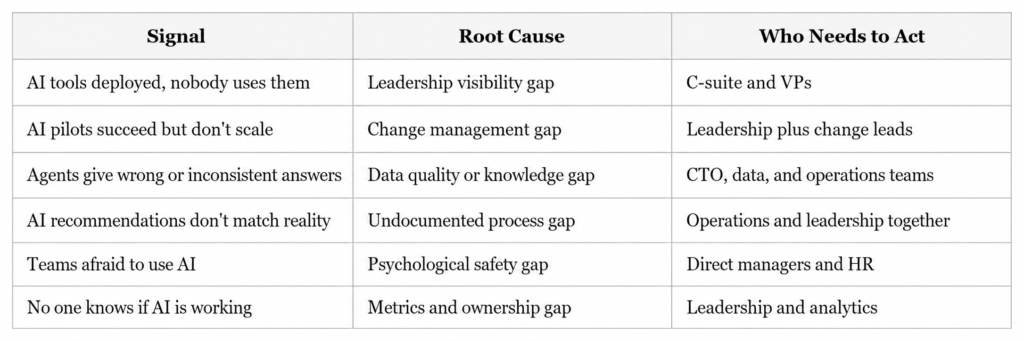
Most organizations have problems in multiple columns at once. The common thread is that none of these get fixed without leadership actively identifying the problem, naming it publicly, and committing resources to solve it.
If you’re serious about closing the gap between “we have AI” and “AI is working for us,” start with these three questions in your next leadership session.
One: Where is AI visibly showing up in our leadership behavior? Not in slides. In actual day-to-day decisions, communications, and reviews. If the honest answer is “not really anywhere,” that’s where to start.
Two: Who owns AI outcomes across this organization? Not IT. Not a vendor. A named individual with authority, accountability, and a direct line to leadership. If you can’t answer this in thirty seconds, ownership doesn’t exist.
Three: What does success look like in ninety days? Not annual ROI projections. A concrete, measurable outcome that proves the investment is moving in the right direction. If there’s no near-term success metric, there’s no accountability loop.
These aren’t complicated questions. But they require an honest conversation that many leadership teams keep avoiding because they’re busy and because the status quo feels comfortable.
The status quo, meanwhile, is getting more expensive every quarter.
McKinsey’s research identifies a consistent pattern among AI high performers. They’re not necessarily the companies with the biggest budgets or the most sophisticated technology. They’re the companies where senior leaders demonstrate visible ownership of AI initiatives, actively use AI themselves, and role-model the adoption behavior they want to see.
These organizations treat AI not as an IT capability but as a business capability. The difference in framing changes everything: who owns it, how it’s resourced, how progress is measured, and how it’s talked about internally.
They also do something that most organizations skip. They redesign workflows rather than bolting AI onto existing ones. Leaders at these companies are willing to ask harder questions about how work actually flows, where decisions get made, and what needs to change structurally for AI to deliver real value.
That kind of organizational introspection doesn’t happen at the team level. It requires leadership to drive it.
There’s a version of this story that ends well, and a version that doesn’t. The difference isn’t the quality of the AI tools, the size of the implementation budget, or the enthusiasm of the early adopters.
The difference is whether your leaders treat AI as someone else’s problem or as their own.
When leadership isn’t driving AI adoption, you get pilots without scale, investments without returns, and teams that quietly go back to doing things the way they always have. When leadership does drive it, you get the 3x performance multiplier McKinsey observed. You get teams that feel permission and urgency to change. You get an organization that actually transforms.
The infographic above puts it plainly: “If leaders don’t actively use AI, teams won’t prioritize it. Adoption starts at the top.” That’s not a motivational phrase. That is an operational truth backed by the data.
Your next move is not another pilot. It’s a leadership conversation about ownership, visibility, and accountability. Start there, and everything else becomes easier.
At Ysquare Technology, we help enterprise and growth-stage companies identify exactly where their AI adoption is breaking down and what leadership, data, and infrastructure changes are needed to fix it.
If your AI investments aren’t delivering what you expected, the problem is almost certainly upstream of the technology. Let’s find it together.
Connect with us on LinkedIn or visit www.ysquaretechnology.com to start the conversation.
How can you supercharge your business with bespoke solutions and products.