Here’s a question most leadership teams haven’t seriously answered yet: if your AI agent made a critical error right now, who would catch it — and how fast?
If the honest answer is “we’d probably find out eventually,” your organization has a Human-in-the-Loop (HITL) problem. And it’s one of the most expensive blind spots in enterprise AI today.
Think about this: an AI agent handling customer refunds quietly approves transactions that should have been escalated. No alert fires. No human checks in. Days pass. By the time someone notices, the same error has played out dozens of times. That’s not a technology failure — that’s a missing checkpoint.
This happens more often than people admit. The absence of human oversight in AI workflows isn’t usually a deliberate call. It’s a gradual erosion — one skipped review, one assumed safeguard, one process that “we’ll monitor later.” Leadership typically finds out only after a public incident or an operational blowup.
This post, part of our ongoing AI Agent Readiness Series, breaks down what human-in-the-loop AI actually means, what the data says about risk, and how to build real oversight into your AI agent workflows before something goes wrong.
Let’s be honest — “human-in-the-loop” has become one of those phrases people nod at without unpacking. So here’s what it actually means in the context of AI agents.
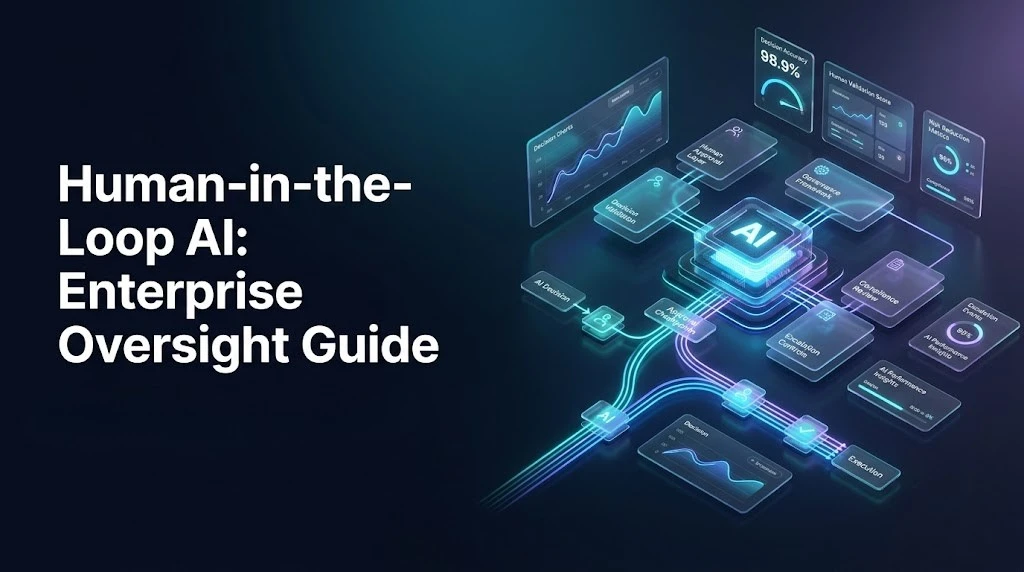
HITL is a deliberate system design where a real person reviews, approves, or can override an AI agent’s decision before it becomes irreversible — especially in high-stakes situations. It’s not checking a dashboard occasionally. It’s embedding human judgment at the specific points in a workflow where the cost of a wrong decision is too high to leave entirely to automation.
Without this, an agent that pulls incorrect data, sends the wrong email, or approves a flawed transaction will simply proceed. The damage happens before anyone looks at a log.
Here’s the catch: HITL isn’t a single switch you flip. It’s a series of strategic decision points woven through an agent’s workflow — from how it sources data, to what actions it’s allowed to take autonomously, to where it must stop and wait for a human call. Miss any of those points, and you’ve left a gap.
It’s closely related to the concept of an approval or review layer in AI systems, but goes further. An approval layer is procedural — it defines a step in the process. HITL is the human actually exercising judgment at that step. It also gives practical meaning to AI agent boundaries — because boundaries only work when someone is positioned to enforce them in real time.
This isn’t a hypothetical risk. According to a 2026 study by IBM’s Institute for Business Value, conducted with Oxford Economics across 2,000 senior technology executives, organizations averaged 54 AI agent incidents in the past year that required human intervention to correct. Of those, 17% were classified as high-severity, taking over four hours to contain.
What happened during those high-severity incidents?
And those are just the incidents that were documented.
The same IBM research found that two-thirds of CIOs and CTOs are now accountable for AI systems they don’t fully control. 70% said business units are deploying AI faster than IT can track. 77% reported that AI adoption is outpacing governance. Only 11% felt genuinely prepared for the scale of agent deployment coming in the next twelve months.
The real question is: what separates the organizations managing this well from those learning lessons the hard way? IBM’s analysis found that organizations embedding governance and control mechanisms directly into their AI systems experienced 25% fewer incidents than those relying on manual oversight after the fact. That gap tells you everything.
This connects directly to a broader vulnerability: security frameworks built only for human users. Traditional security assumes a person is behind every action. When an AI agent operates autonomously, that assumption breaks down — and HITL mechanisms are what re-establish meaningful control.
McKinsey’s 2025 State of AI report, drawn from nearly 2,000 respondents across approximately 105 countries, found that 51% of organizations experienced at least one negative consequence from AI in the past year. Inaccuracy was the most common culprit, affecting 30% of respondents.
What most people miss in that stat is what it implies at scale. An error rate that seems manageable in a ten-transaction-a-day pilot becomes a genuine liability when the same agent processes tens of thousands. Inaccuracy doesn’t stay small — it scales with the agent.
Here’s the data point that matters most: high-performing organizations were significantly more likely to have defined HITL validation processes — 65% of them had one, compared to just 23% of other organizations. That’s not a minor gap. That’s the structural difference between companies that can safely scale AI and those that end up scaling their mistakes.
Part of why errors spread unchecked relates to data integrity. As explored in our coverage of multiple versions of truth in AI systems and the breakdown of conflicting data, a human reviewer is often the only barrier between a minor data conflict and a decision that affects a real customer. Without clear metrics for AI performance, most organizations won’t even know how often this is happening until a complaint or audit surfaces it.
Gartner’s June 2025 forecast delivers a blunt warning: more than 40% of agentic AI projects are predicted to be cancelled by the end of 2027. The primary reasons cited — escalating costs, unclear business value, and inadequate risk controls — aren’t technical failures. They’re governance failures.
Here’s how it typically plays out. Leadership approves an agentic AI budget based on promised efficiency gains. The agent goes live. Oversight is minimal. Errors accumulate quietly. Then the cost of correcting those errors starts appearing on the balance sheet — and suddenly the CFO is asking whether this was worth it. The project gets cancelled. Not because AI failed, but because the governance around it did.
Two factors consistently drive this pattern. First, when leadership isn’t actively engaged with AI adoption, the conversation about where human checkpoints should sit never gets escalated beyond the project team. Executives don’t know what to ask about, so they don’t ask.
Second, when there’s no clear ownership of AI systems, no one is accountable for monitoring performance. Oversight becomes everyone’s responsibility in theory and no one’s responsibility in practice.
Not every AI task needs constant human scrutiny. A tool that summarizes internal notes operates very differently from one that approves a loan or updates a patient record. The real expertise is knowing precisely where to draw that line.
KPMG’s Q4 AI Pulse Survey found that over 60% of enterprise leaders use HITL controls across high-risk workflows. The same survey found that 60% restrict AI agent access to sensitive data without human oversight — which also tells you that a meaningful portion still don’t have these basic safeguards in place.
Speed compounds the risk. As covered in our post on why AI agents fail without real-time data access and its companion LinkedIn piece, agents operating on live data streams make decisions at a pace no human can match in real time. That speed is the point — it’s why you’re using AI. But it’s also exactly why a clearly defined human checkpoint becomes more important, not less.
There’s also a documentation problem. If your operational workflows exist only in people’s heads and aren’t formally documented, you can’t confidently place a human review point in them. You can’t put a checkpoint on a process that’s never been written down.
There’s a factor that quietly undermines HITL before it even has a chance to work: scattered knowledge.
As explored in our post on scattered knowledge sabotaging AI agent readiness and the related LinkedIn article, when critical information is fragmented across disconnected systems, the human reviewer is often working with less context than the AI agent itself has. They’re approving decisions they don’t fully understand — which makes the entire oversight process theatre, not safety.
Outdated documentation makes this worse. A reviewer trained on old process guides will confidently approve the wrong thing. As covered in our analysis of what happens when documentation lies to your AI agents, the HITL system is only as good as the information the human reviewer brings to it. If that information is stale or incomplete, oversight fails even when the process looks correct on paper.
Effective HITL doesn’t mean adding a human approval to every single AI action — that would defeat the purpose of automation entirely. The goal is strategic placement: putting human judgment exactly where the cost of error is too high to leave unreviewed.
Don’t just document what the agent is supposed to do — document every action it’s technically capable of taking. Then categorize those actions by consequence. Sending a status update is low-risk. Issuing a refund, changing account permissions, or modifying patient records is not. High-consequence actions need human sign-off before execution, not after.
Not a team. Not a department. A specific person. If something goes wrong, there needs to be one name attached to the responsibility of that review. Vague accountability is no accountability — and that’s exactly the kind of gap that lets errors accumulate quietly.
If your human reviewers are overriding AI decisions 10% of the time on a specific task, that’s a signal — not just a checkpoint catching errors. It means something upstream is wrong: data quality, agent training, or workflow design. HITL data should feed back into continuous improvement, not just incident response.
Removing human oversight from AI decisions doesn’t make your organization faster. It makes it blind.
The data is consistent: organizations with embedded governance and control mechanisms report significantly fewer AI agent incidents. And analyst research links weak risk controls directly to the cancellation of AI projects that showed genuine promise.
The real question isn’t whether to include human oversight. It’s where — and that decision needs to be made before deployment, not after the first significant incident. This is a leadership call, not an engineering afterthought. It’s one of the clearest dividing lines between organizations that scale AI safely and those that end up explaining a very public mistake.
If your organization is still working out where those checkpoints should sit, that conversation is long overdue.
How can you supercharge your business with bespoke solutions and products.