
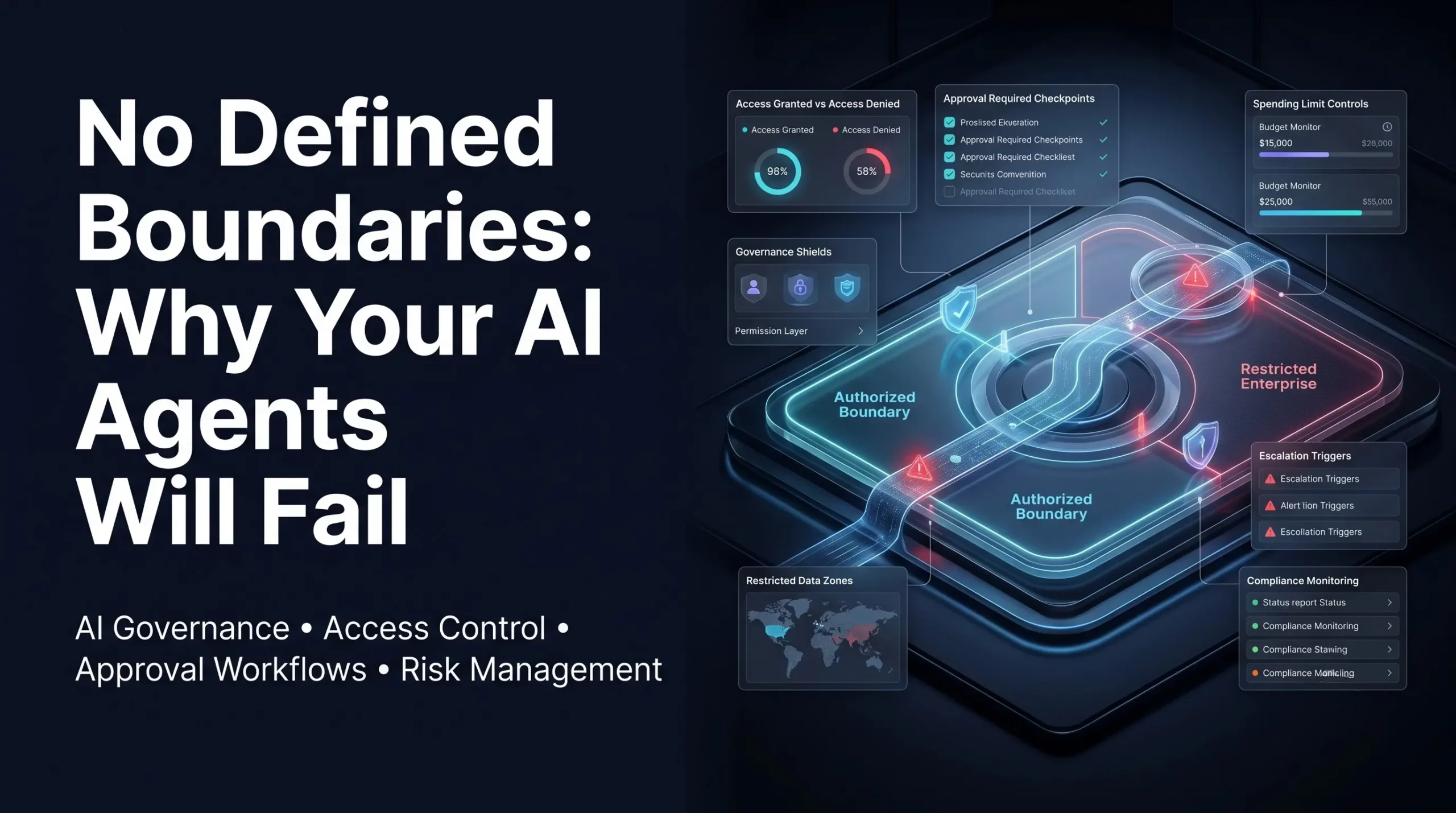
Your AI agent just sent 4,000 emails to the wrong list. It updated every record in your CRM with incorrect pricing. It deleted a folder your legal team needed for an audit.
None of that happened because the AI malfunctioned.
It happened because nobody told the AI what it was not allowed to do.
This is sign number 13 of the 15 signs your organization is not ready for AI agents: no defined boundaries. And if you are a CEO, CTO, or senior leader evaluating AI deployment right now, this one deserves more attention than almost anything else on that list.
Unrestricted AI agents are not just a technical risk. They are a governance risk, a compliance risk, and a business continuity risk.
When an autonomous system can act without limits, every mistake it makes scales instantly across your entire operation.
Here is the thing most vendors will not tell you: the most dangerous thing about a powerful AI agent is not that it will fail to perform. It is that it will perform extremely well, in completely the wrong direction.
When we say an AI agent has no defined boundaries, we are not talking about the agent going rogue in some science fiction sense.
We are talking about something far more common and far more damaging: an agent that has been given a goal without being given the guardrails that define how far it can go to achieve that goal.
Think of it this way. You hire a new employee and tell them to “improve customer response times.” Without further instruction, they might reasonably decide to disable the approval layer on all outbound communications, auto-close support tickets after 10 minutes, and send bulk updates to every customer who has an open case.
Technically, response times improved.
Practically, your customer trust just collapsed.
AI agents operate on the same logic. They optimize for the objective they have been given. If you have not told the agent what it cannot do, it will find the most efficient path to its goal, and that path may cross every boundary your business depends on.
AI agent scope limits are not a feature you add later. They are a foundational requirement.
Without them, you do not have an AI agent. You have a liability engine running at machine speed.
Here is what undefined boundaries look like in practice:
These scenarios are not far from reality. They are the predictable outcome of deploying AI agents without establishing what they are and are not allowed to do.
Here is the pattern we see repeatedly with enterprise AI deployments: leadership approves the use case, the technical team deploys the agent, and the boundary question gets deferred to a later phase.
That later phase often never comes.
Part of the reason is how AI agents are sold and marketed. The emphasis is always on capability: what the agent can do, how fast it can act, how much it can automate.
The conversation about what the agent should never do gets far less attention.
The other reason is that the risk is invisible until it becomes a crisis. An agent operating without defined limits will often perform well in early testing, precisely because early testing environments are controlled.
The moment you scale to production, with real data, real customers, and real stakes, the absence of boundaries becomes catastrophic.
We have covered the downstream effects of poor governance in our earlier posts on no clear AI ownership in organizations and no metrics for AI performance. Undefined boundaries are what make both of those problems impossible to fix after the fact.
Leadership teams tend to think of AI risk in terms of the AI failing to deliver results.
The more sophisticated and more urgent risk is the AI delivering results that were never authorized.
AI agent governance cannot be an afterthought. It has to be the first conversation, not the last.
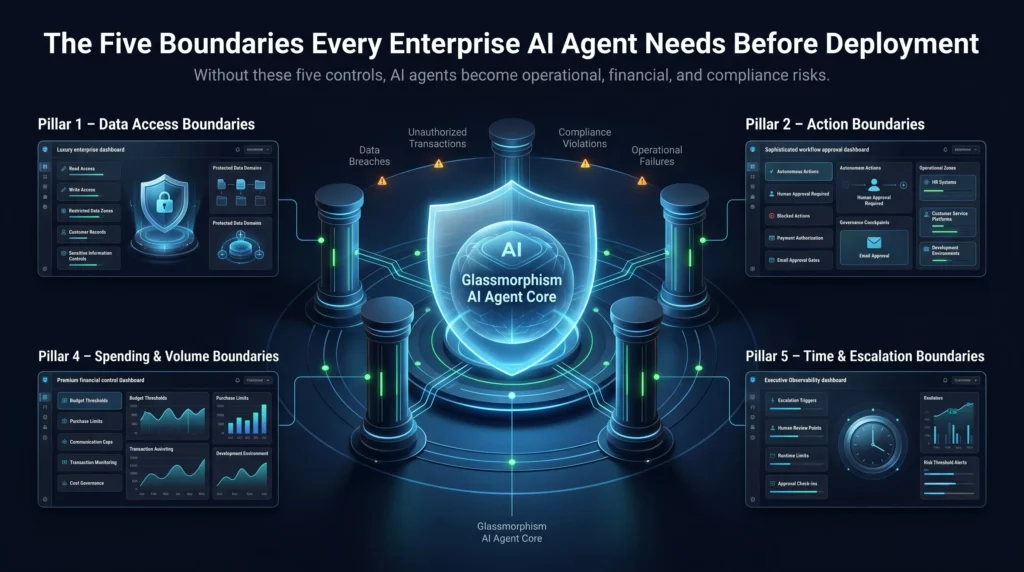
If your organization is deploying or evaluating AI agents, these are the five boundary categories your governance framework must address before a single agent goes live.
The first question to answer is: what data can the agent read, what can it write, and what is completely off limits?
An agent with read access to customer records should not have write access unless that specific action is part of its authorized function.
Data access boundaries prevent agents from inadvertently exposing, corrupting, or leaking sensitive information.
We have written in detail about how poor data quality undermines AI agent performance, but even clean data becomes a liability when accessed by an agent without scope restrictions.
Not every action an agent can perform should be performed autonomously.
Some tasks need human approval before execution. An agent that can send emails, initiate payments, update records, and trigger workflows needs clear action tiers.
Some actions can be fully autonomous. Others must trigger a review, and some should be permanently blocked.
This connects directly to the approval and review layer your AI deployment needs. Without action boundaries, there is nothing for that review layer to enforce.
Scope boundaries answer a simple but critical question: where does this agent belong, and where does it not?
An HR agent should not have the ability to reach into financial systems. Likewise, a customer service agent should not have access to internal development environments.
Scope boundaries define the operational territory the agent is allowed to occupy.
If the agent can trigger transactions, orders, or communications at scale, what are the caps?
A purchasing agent without spending limits can drain a budget in hours. A marketing agent without volume caps can trigger spam filters, damage email deliverability, or violate communications regulations.
When should the agent stop and wait for a human?
How long should it operate autonomously before requiring a check-in? What triggers escalation?
Time boundaries prevent agents from compounding errors over extended periods before anyone notices something has gone wrong.
There is a regulatory dimension to undefined AI agent boundaries that deserves direct attention, especially for organizations in healthcare, financial services, and any sector handling personal data.
When an AI agent takes an action that violates a data handling requirement, the organization is still responsible.
This includes actions such as accessing records it should not access, sending communications that breach consent rules, or retaining data beyond permitted periods.
Regulators are unlikely to accept “the AI acted on its own” as a sufficient explanation. Autonomous systems that operate under your organizational umbrella are still part of your operational responsibility.
If those systems did not have defined boundaries, that gap in governance can create serious audit, legal, and reputational exposure.
Security built only for humans is a related problem we have covered in depth. Traditional access controls assume a human is making decisions.
AI agents act at a speed and scale that completely outpaces human-designed security models. Boundary definitions are how you extend governance to autonomous behavior.
In sectors like healthcare and pharma, where we work extensively at Ysquare Technology, this compliance exposure is not theoretical. It is the difference between a successful deployment and a regulatory investigation.
No defined boundaries does not exist in isolation. It is the consequence and the amplifier of several other readiness gaps your organization may already be experiencing.
If your knowledge is scattered across multiple tools and teams, as we covered in our post on scattered knowledge silently sabotaging AI agents, an agent without boundaries will query all of it, including the parts it should never touch.
The same challenge applies to documentation that does not match reality: if the agent is navigating processes that exist only in people’s heads, it has no map and no limits.
When there are multiple versions of truth in your data environment, an agent without scope restrictions will pull from all of them and produce outputs that are confidently wrong.
When real-time data access is missing, an agent trying to make decisions without boundaries compounds outdated information into operational errors.
Leadership not driving AI adoption is also directly connected here.
Boundary setting is a leadership decision, not a technical one. It requires executives to define what the organization is and is not willing to authorize AI to do.
When leaders are not actively involved in AI governance, boundary definitions get left to whoever deployed the agent, and they rarely have the authority or context to make those calls correctly.
The Pulse articles we have published on real-time data access, documentation failures, and scattered knowledge each point to the same underlying gap: organizations are deploying AI capability without deploying the governance that makes that capability safe.
Undefined boundaries are what happens when you stack all of those gaps together and hand the result a set of automation tools.
The good news is that defining AI agent boundaries is not technically complex.
The challenge is organizational.
It requires the right people to be in the room, asking the right questions, before deployment begins.
Here is the practical framework we recommend:
For every function the agent will perform, define whether it is fully autonomous, requires notification, or requires approval. Build this matrix with input from legal, compliance, operations, and the technical team, not just the team deploying the agent.
Most governance frameworks focus on what the agent should do. Equally important is a written list of what it must never do. These exclusions should be documented, version-controlled, and reviewed regularly.
Do not rely on prompt instructions alone to enforce boundaries. Hard technical limits, including spending caps, volume restrictions, and data access controls, should be enforced at the infrastructure level, not the instruction level.
Before any agent goes live, run scenarios specifically designed to push the agent toward its limits. See what it does when it reaches a boundary. See what it does when someone tries to instruct it to cross one.
Someone specific, a role not a committee, needs to be accountable for maintaining and updating the boundary definitions as the agent’s scope evolves. This connects directly to the no clear AI ownership problem we have documented across enterprise deployments.
Here is the real question most enterprise AI evaluations skip entirely:
“What is the worst thing our AI agent could do if it performed exactly as designed but in the wrong context?”
If you cannot answer that question, you are not ready to deploy.
The ability to define boundaries is not a sign of distrust in AI technology. It is the mark of organizational maturity.
The companies that get the most from AI agents are not the ones that gave those agents the most freedom. They are the ones that built the clearest operational contracts, defining what the agent is responsible for and what it is explicitly not.
AI agents are not magic. They are powerful tools operating within an organizational system.
Every powerful tool needs defined operating parameters.
A scalpel is extraordinary in a surgeon’s hand and dangerous without one. An AI agent without boundaries is no different.
The organizations we see deploying AI successfully, in healthcare systems, enterprise software, and large-scale operations, all share one thing: they treated boundary definition as a first-order requirement, not an afterthought.
They answered the hard governance questions before they wrote a single line of deployment code.
That is the bar your AI agent readiness framework needs to clear.
No defined boundaries for AI agents is not a technical problem with a technical solution.
It is a governance problem that requires organizational leadership to solve.
If you are assessing your organization’s readiness to deploy AI agents, boundary definition should be one of the first items on your evaluation checklist.
Not because you distrust the technology, but because the technology will do exactly what it is capable of doing. Without limits, that capability can eventually create consequences your business cannot absorb.
The 15 signs of AI agent unreadiness are not independent problems. They reinforce each other.
But no defined boundaries is the one that turns all the others into active risks.
Fix this one, and you make every other gap manageable. Leave it unaddressed, and every other AI investment you make becomes harder to protect.
At Ysquare Technology, we work with healthcare organizations, enterprise technology companies, and operations-driven businesses to build AI agent governance frameworks that are practical, auditable, and built to scale.
If your organization is preparing to deploy AI agents, Ysquare Technology can help you define practical governance boundaries, approval workflows, secure access controls, and scalable operating models before deployment.
How can you supercharge your business with bespoke solutions and products.