You approved the AI agent rollout. The demos looked impressive. The pilot numbers justified the investment. And then, a few quarters later, your finance team flagged an infrastructure report that made no sense.
The costs had tripled. Quietly. Without warning.
Nobody caught it because nobody was watching. No dashboards. No spending thresholds. No assigned owner. Just agents running continuously, calling APIs, processing data, and generating costs that nobody reviewed until the numbers became impossible to ignore.
This is Sign 15 in Ysquare’s AI Agent Readiness Series: No Cost Monitoring. It is one of the most financially damaging gaps an enterprise can leave open, and it is far more common than most technology leaders realize. The organizations that have scaled AI successfully share one consistent trait: they treat cost visibility with the same discipline they apply to performance visibility. Non-negotiable, real-time, and clearly owned.
If your organization is running AI agents without a financial monitoring layer, this article is written for you.
AI agent cost monitoring is the ongoing practice of tracking, attributing, and managing every expense generated by your AI agents in real time. It is not the same as reviewing your monthly cloud bill. It goes much deeper than that.
Most enterprise leaders think about AI costs as a single line item. In reality, AI agent spending is distributed across several distinct categories, each with its own behavior, scaling pattern, and risk profile.
This last point connects to something we have covered in detail in our article on how poor data quality silently inflates AI agent costs. The financial impact of data quality problems does not stay in the data layer. It flows directly into your AI agent operating costs.
The question executives often ask is a fair one: how does this happen in organizations that already have financial controls in place? The answer is that AI agent deployments create a set of conditions that make cost overruns unusually easy to miss.
Every AI agent deployment starts with a pilot. The pilot is intentionally limited in scope, controlled in volume, and closely watched by a small team. Costs during this phase are predictable and manageable. Leadership sees a favorable cost-to-output ratio, approves full-scale deployment, and moves on.
What nobody accounts for is how dramatically the cost structure changes when agents move from pilot to production. A pilot running 50 tasks per day becomes a production system running 5,000 tasks per day. API costs that were negligible become a significant operating expense. Compute costs that fit comfortably within a development budget grow into a line item that requires active management.
Because no monitoring infrastructure was built during the pilot, the production cost reality only becomes visible when a billing report arrives. By that point, weeks or months of unnecessary spending have already occurred.
Untracked costs and unclear ownership almost always appear together. When no single person or team is financially accountable for AI agent operations, cost overruns have no natural owner to surface them. They drift. Quietly and continuously.
This is a pattern we have written about directly in our article on no clear AI ownership in organizations. The absence of ownership is not just a governance problem. It is a financial risk that compounds over time.
In most large enterprises, AI agent deployments do not happen exclusively through a central technology team. Individual business units, product teams, and developers spin up their own agent workflows. Some of these are formally approved. Many are not. Each operates within its own budget silo, invisible to any consolidated view of AI spending.
This fragmentation means that even when some AI costs are tracked, the total picture is never complete. Finance teams work from partial data. Technology leaders make investment decisions without understanding the real baseline. And the gap between tracked and actual AI spending widens every quarter.
Understanding that the problem exists is one thing. Understanding what it actually costs the business is what should compel leadership to act.
When AI agent costs are not tracked in real time, finance teams cannot build reliable forecasts. They work from estimates based on pilot data that no longer reflects production reality. Annual budget cycles incorporate assumptions that are often off by a wide margin.
The downstream effect is that technology investment decisions become harder to defend. CFOs ask for cost justification. Technology leaders cannot provide it because the data does not exist in a usable form. This creates a cycle where AI investments face more scrutiny, approvals slow down, and the organization loses momentum at exactly the moment it should be accelerating.
AI agents are supposed to generate value that exceeds their cost. But when costs are unmonitored, that equation cannot be verified from either side. You know what the agents are doing. You may even have a sense of the productivity gains they are delivering. But you cannot close the financial loop because the denominator is unknown.
This matters most when leadership is trying to make the case for expanding AI investment. Without accurate cost data, the ROI argument rests on anecdote rather than numbers. That is a fragile foundation for decisions that require board-level approval or significant budget reallocation.
We explored this challenge directly in our article on no metrics for AI performance. Cost is one of the most important metrics in that framework, and the absence of it undermines every other measurement your organization tries to build.
Here is something that surprises many technology leaders when they first implement cost monitoring: a meaningful portion of their AI agent spending is being consumed by agents that are operating inefficiently. Not failing completely. Not producing zero output. Just performing at a fraction of their potential efficiency while consuming far more resources than they should.
An agent querying an oversized data source for every task when a filtered subset would do. An agent running a six-step reasoning chain for questions that require two steps. An agent retrying a failed integration call repeatedly instead of failing gracefully and escalating.
Without cost monitoring, none of these inefficiencies produce a visible signal. The agents keep running. The costs keep accumulating. And the optimization opportunity goes unrecognized until someone builds the visibility layer that makes it apparent.
Every organization running AI agents at scale will eventually need to negotiate contracts. API pricing agreements. Infrastructure volume commitments. SaaS integration terms. These negotiations require accurate usage data to be effective.
Organizations without cost monitoring walk into these conversations blind. They cannot demonstrate their actual usage patterns. They cannot make the case for volume-based discounts. They cannot identify which pricing structures favor their specific workload profile. The result is consistently worse commercial outcomes than would have been possible with proper visibility.
Getting cost monitoring right is not about deploying a single tool and calling it done. It requires building a set of interconnected capabilities that together create genuine financial visibility.
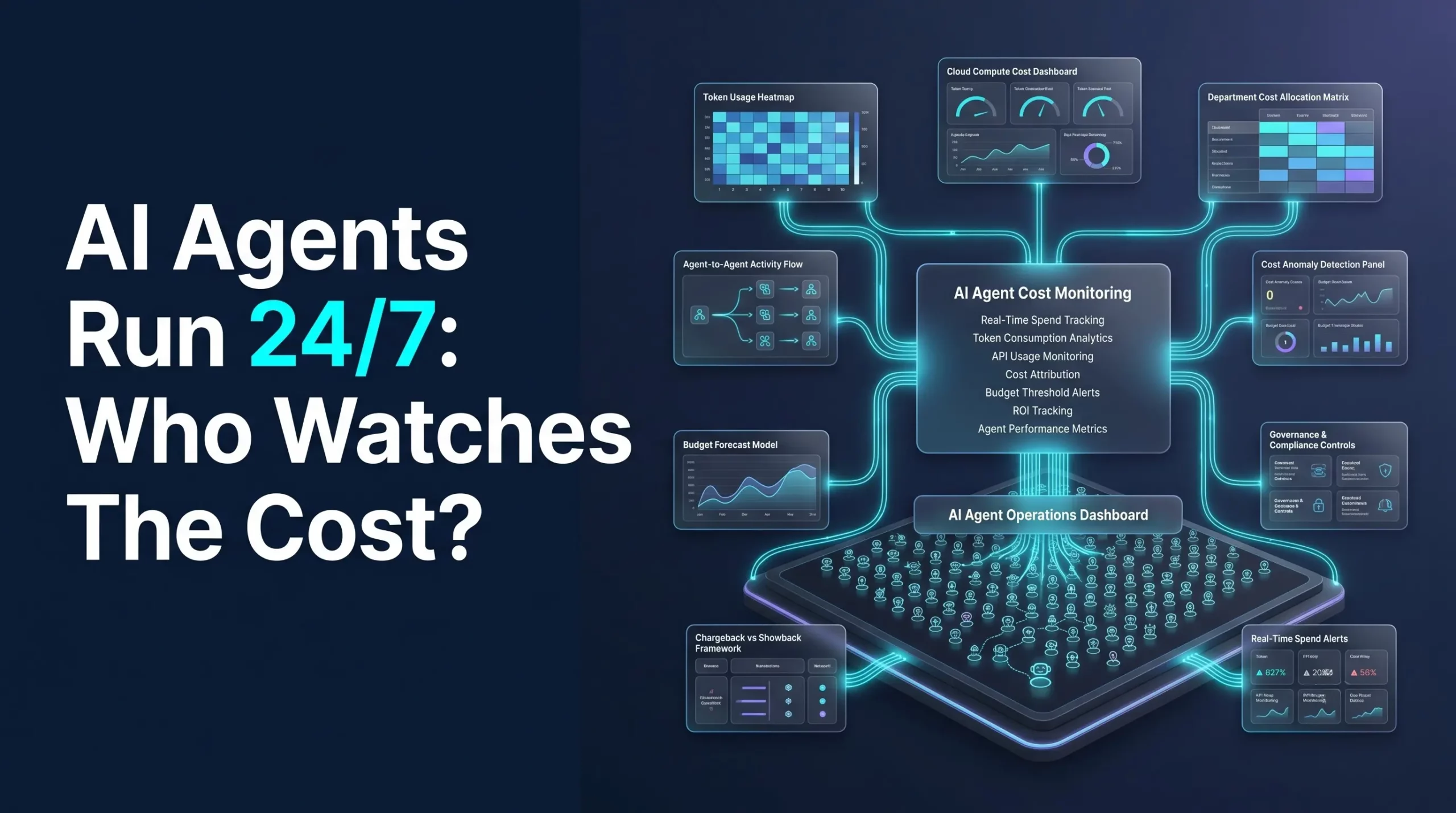
The foundation is a real-time view of what every AI agent is spending, broken down by agent, by workflow, by business unit, and by time period. This is the same principle that drives mature organizations to build real-time data access for operational AI systems. Delayed data is not operational data. If your cost view is 30 days old, you are managing by looking in the rear-view mirror.
This visibility layer needs to capture the full cost picture: API call costs, compute consumption, integration usage, and where possible, the cost impact of errors and retries.
Dashboards tell you what has happened. Alerts tell you what is happening right now. Build threshold-based alerts that trigger when a specific agent exceeds its daily spending limit, when API call volume spikes beyond expected ranges, or when error rates climb in ways that suggest retry loops are inflating costs.
The target is to surface a cost anomaly within hours, not at the end of a billing period. An alert triggered on day two of an unexpected cost spike saves far more than one triggered on day thirty.
Enterprise AI deployments span multiple teams. Cost monitoring needs to reflect that reality. Each business unit deploying AI agents should receive regular visibility into their specific spending, compared against their approved budget and against the business outcomes their agents are producing.
This structure does two things simultaneously. It gives central leadership a consolidated view of total AI spending. And it gives individual business units the information they need to manage their own usage responsibly. Both matter.
Total spending tells you how much your AI agents cost. Cost per outcome tells you whether that spending is justified. Track cost per task completed, cost per successful outcome, and cost per unit of measurable business value delivered.
These metrics make it possible to compare efficiency across different agents and workflows. They surface the cases where an agent is technically working but operating at a cost that does not make business sense. And they create the financial vocabulary that technology leaders need to have credible conversations with finance and executive leadership.
If your organization has already addressed the security model for AI agents and the approval and review layer for AI outputs, cost per outcome metrics are the natural next layer of operational maturity.
Theory is useful. Action is better. Here is a practical five-step path that CEOs, CTOs, and technology leaders can follow to build real financial visibility into their AI agent operations.
Before you can monitor, you need to know what you are monitoring. Start by identifying every AI agent your organization is running, including those deployed by individual teams outside formal approval processes. Map each agent to its primary cost drivers: API usage, compute, storage, and third-party integrations.
This audit almost always surfaces significantly more spending than technology or finance teams expected. That discovery is not a failure. It is the first step toward control.
Every AI agent deployment needs a financial owner. This does not require creating new roles. In most cases the right owner is already the person or team responsible for the business function the agent serves. What changes is making that financial accountability explicit: they are responsible for monitoring spending, responding to alerts, and participating in monthly cost reviews.
This is the principle that most organizations get backwards. They scale first and build monitoring later. The monitoring retrofit is always harder, more expensive, and slower than building it into the deployment from the start.
If you have a pilot ready to go to production, build the monitoring layer first. Instrument your cost tracking. Configure your alerts. Establish your reporting cadence. Then scale. By the time the production system is running at full volume, you have complete financial visibility from day one.
A global AI budget is not enough. You need cost budgets at the individual agent and workflow level. These budgets should reflect the expected value each agent delivers. A high-value workflow justifies a higher cost ceiling. A routine administrative automation needs a tighter constraint.
These budgets become the reference points against which your monitoring alerts are calibrated. They also create the accountability structure that cost owners need to manage their deployments responsibly.
Cost monitoring data is only valuable if it drives decisions. Schedule a monthly review where cost owners present their spending actuals against budget, identify their highest-cost agents, and bring a perspective on whether those costs are proportionate to the value delivered.
This review is also the right place to surface opportunities to optimize. Agents running undocumented workflows that may be driving unnecessary activity or processing redundant data from multiple conflicting sources are often the highest-cost, lowest-efficiency systems in the portfolio. Monthly reviews make these visible before they become entrenched.
Even organizations that commit to cost monitoring often fall into patterns that reduce its effectiveness. These are the most common.
Infrastructure compute is the most visible AI cost because it appears on cloud billing statements. But in many enterprise AI deployments, API call costs and third-party integration fees can become as important as infrastructure costs. An organization that only monitors compute spending may be missing a large part of its actual AI expenditure while assuming it has full visibility.
Build monitoring that captures every cost category, not just the one that is easiest to see.
Alert systems fail when they generate too much noise or when alerts have no assigned owner. Both conditions lead to the same outcome: alerts get ignored, the monitoring system develops a reputation for being unhelpful, and cost overruns continue unchecked despite the infrastructure that was supposed to prevent them.
Every alert needs an owner. Every category of alert needs a defined response protocol. And the alert threshold configuration needs regular review to ensure it is generating actionable signals, not background noise.
AI agent usage patterns evolve continuously. New workflows get added. Agent behavior changes as models are updated or prompt configurations shift. Seasonal usage patterns create periods of elevated activity. A monitoring configuration that was well calibrated six months ago may be generating false signals today.
Build a quarterly review of your monitoring setup into your operational calendar. Revisit thresholds, attribution rules, and alert configurations with the same discipline you apply to the agents themselves.
The most complete picture of AI agent value comes from tracking cost and performance together. An agent with low costs but poor output quality is not a success. An agent with high costs delivering exceptional business value may be your most important asset. When cost monitoring and performance monitoring operate as separate systems with no connection between them, the full picture never emerges.
Connect your cost data to your performance metrics. Evaluate agents on cost-adjusted outcomes. This is what separates organizations that are managing their AI investments from those that are simply observing them.
It would be easy to frame AI cost monitoring as a technology problem. Build the right dashboards, configure the right alerts, and the problem is solved. That framing misses the real issue.
Cost monitoring fails in organizations not because the technical tools are unavailable, but because leadership has not made it a priority. When leadership is not actively driving AI governance, financial oversight falls into the same gap. Nobody owns it because nobody at the top has made clear that it matters.
The organizations that execute AI cost monitoring well have leaders who treat AI spending as a first-class financial category. Not a subset of IT. Not a discretionary budget that gets reviewed annually. A managed expense category with real-time visibility, clear ownership, and monthly accountability.
That posture starts at the top. If the CEO and CFO are asking for AI cost data with the same regularity they ask for revenue and operational metrics, cost monitoring gets resourced and maintained. If they are not asking, it drifts.
There is a meaningful difference between organizations that are experimenting with AI agents and organizations that are leading with them. The difference is not primarily about the sophistication of the agents they deploy. It is about the maturity of the operational infrastructure around those agents.
Cost monitoring is a core part of that infrastructure. It is not optional for organizations that are serious about scaling AI responsibly. Every quarter of operation without proper financial visibility is a quarter of compounding inefficiency, missed optimization opportunities, and reduced credibility with the stakeholders who control the budgets AI programs need to grow.
If your organization is working through the challenges covered in this series, from scattered knowledge bases to documentation that does not match operational reality to real-time data access gaps, Ysquare Technology works with enterprise teams to build the operational foundation that makes AI agent deployments measurable, accountable, and financially sustainable.
Follow Ysquare Technology on LinkedIn to continue following this series, or connect with our team directly to discuss where your organization stands today.
How can you supercharge your business with bespoke solutions and products.