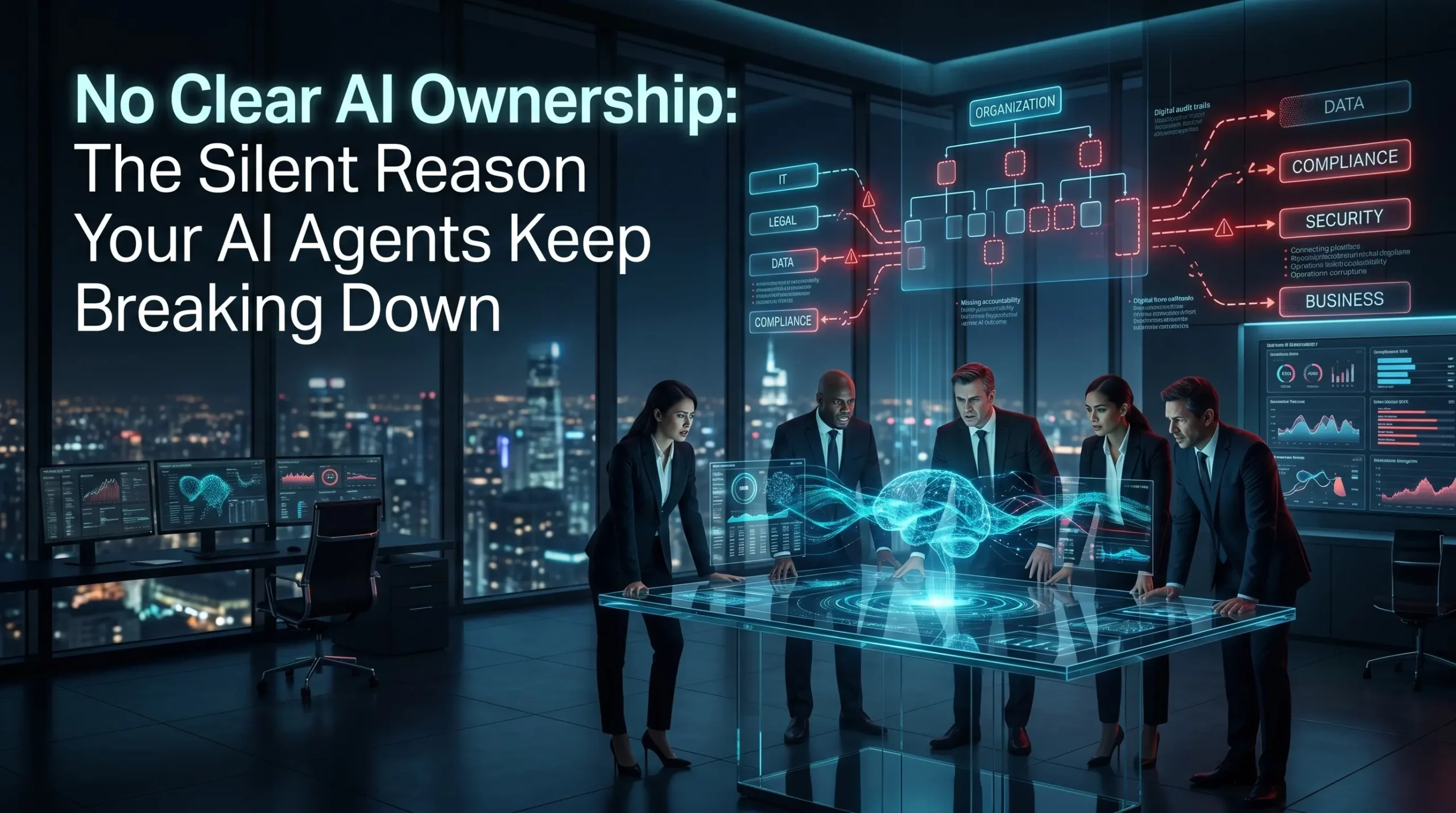
Your AI agent goes live. It works. Then three weeks later, something quietly goes wrong. Outputs start drifting. A workflow sends the wrong notification. A report pulls stale data. And when you ask who is responsible for fixing it, everyone looks at someone else.
That is not a technology problem. That is an ownership problem.
No clear AI ownership in organizations is one of the most overlooked readiness gaps in enterprise AI today. You can build the most sophisticated agent in the world, but if nobody is accountable for its outcomes, it will fail. Slowly. Quietly. Expensively. This piece is part of our AI Agent Readiness Series, and it addresses Sign 11 from the framework: No Clear Ownership. If you have been nodding along to other signs in this series, like scattered knowledge silently sabotaging your AI or multiple versions of truth killing your data decisions, this one will hit close to home.
Let’s be honest. Most companies deploy AI agents with a lot of excitement and very little clarity on who owns what after go-live.
No clear AI ownership means there is no single person or team formally accountable for an AI agent’s performance, outputs, or continuous improvement. It is not about who built it or who approved the budget. It is about who wakes up at 7 AM when the agent starts sending customers the wrong information.
Here is what this typically looks like in practice:
When issues remain unresolved because nobody is responsible for AI outcomes, the damage compounds every single day. That is the real cost of unclear accountability.
It connects directly to other readiness gaps too. If your documentation does not reflect how work actually happens, then your AI agent is working from a broken map. And if nobody owns the agent, nobody updates that map either.
There is a phrase that applies perfectly here: ownership drives accountability. Without it, you do not have AI-assisted operations. You have AI-assisted chaos with better branding.
Think about what happens when an AI agent makes a wrong decision without a defined owner to catch it. If nobody validates outputs, mistakes can scale quickly. That is not a theoretical concern. In B2B environments where agents handle customer communications, data routing, or financial approvals, a single undetected error can trigger a cascade.
We covered the approval problem in depth in our piece on AI agents failing without an approval or review layer. But even a well-designed approval layer falls apart when no one is accountable for reviewing the reviews.
The real question is not whether your AI agent will ever make a mistake. It will. Every system does. The question is whether you have someone positioned to catch it, correct it, and prevent it from happening again. That person needs a title, a mandate, and the authority to act.
Primary keyword note: AI accountability in business is not a governance checkbox. It is the operating system that keeps your AI investments producing returns instead of producing liability.
Let’s talk about what this actually costs you. Not in abstract terms but in operational reality.
AI agents are not static. Business context changes. Data sources evolve. Customer behavior shifts. Without an owner monitoring performance metrics, your agent keeps running on logic that was accurate six months ago and is quietly wrong today.
This connects directly to the measurement gap. When you are not tracking metrics for AI performance, you have no way to detect that your AI is underperforming until the damage is already done. Ownership without measurement is blind. Measurement without ownership is pointless.
AI systems improve with feedback. That is not a nice-to-have. That is how they work. Without post-launch iteration driven by a named owner, your agent reaches a performance ceiling on day one and stays there.
We wrote about this specifically in the context of no post-launch iteration being a critical AI readiness gap. Without someone accountable for ongoing improvement, the agent becomes a legacy system the moment it goes live.
When your AI agent produces conflicting outputs across departments, someone needs the authority to resolve those conflicts. Without a defined owner, those conflicts sit in email threads and Slack messages for weeks. Meanwhile, the agent keeps producing wrong outputs at scale.
An AI agent operates differently from a human employee. It does not get tired, distracted, or hesitant. When it has access to sensitive systems and nobody owns it, the access permissions set at launch never get reviewed. We explored this in our piece on security systems built only for humans failing AI agents. The ownership gap and the security gap feed each other.
Good AI ownership is not about adding another title to your org chart. It is about clarity. Here is what a functional ownership model looks like in practice.
Every deployed AI agent should have exactly one named owner. Not a committee. Not a shared inbox. One person who is accountable for its performance, its outputs, and its ongoing improvement. That person should be close enough to the business process to understand context and senior enough to make decisions without escalating every change.
Ownership without scope creates confusion. Your AI owner needs to know exactly what they are responsible for. That includes performance benchmarks, error thresholds, data quality standards, and escalation paths when something breaks down.
This connects to the broader problem of real-time data access being a hidden readiness gap. An AI owner needs to know whether the agent is accessing live signals or stale data. That is a scope question before it becomes a technical question.
An AI agent should have a monthly or quarterly performance review the same way a business unit does. The owner leads this review, brings in the right stakeholders, and makes the call on what needs to change. Without structured review cycles, ownership is just a label.
Here is the catch. Ownership only works when leadership actually supports it. If the C-suite treats AI agents as a one-time deployment instead of a living system, your AI owner will be fighting a constant uphill battle. We covered this in our piece on leadership not driving AI adoption as a critical readiness failure. Adoption starts at the top. So does accountability.
Ownership is not an isolated problem. It sits at the intersection of almost every other AI readiness gap.
When you have multiple versions of truth creating conflicting data, an AI owner is the person who decides which version the agent trusts. Without that owner, the agent picks arbitrarily and nobody questions it.
When your documentation does not match how work actually happens, the owner is the person who ensures the agent is updated to reflect real processes, not documented ones.
When real-time data access is blocked or incomplete, the owner escalates that dependency and ensures the agent is not making decisions on outdated signals.
And when knowledge is scattered across silos and tools, the owner maps those silos and ensures the agent knows where to look.
The AI owner is, in effect, the connective tissue between your AI investment and the real business it is supposed to serve.
You do not need a six-month governance program to fix this. You need a few clear decisions made this week.
Most organizations are not. That is not a criticism. It is just the reality of where enterprise AI adoption is right now. The technology has moved faster than the organizational structures needed to govern it.
The good news is that this is one of the most solvable readiness gaps. It does not require new technology. It does not require a massive budget. It requires a decision: who owns this?
Make that decision for every AI agent you currently have running. Then make it mandatory before every future deployment. It sounds simple because it is. The complexity is in building the organizational culture where ownership is respected, supported, and measured.
If you are serious about AI agent readiness, start with our full readiness framework on the Ysquare Technology LinkedIn page. Each sign in the series connects to the others, and ownership is the thread that runs through all of them.
Every time an AI agent fails quietly in a corner of your organization, it erodes trust in AI as a whole. Teams stop using it. Leadership pulls funding. The technology gets blamed when the problem was always structural.
Defining clear AI ownership is how you prevent that. It is how you build AI that improves month over month instead of decaying from launch day. It is how you turn a one-time deployment into a competitive advantage that compounds over time.
The question is not whether your AI can do the job. The question is whether your organization is structured to support it. Start with ownership. Everything else gets easier from there. And if you want a full picture of where your AI readiness stands today, explore our growing series covering all 15 signs, beginning with how scattered knowledge blocks AI agent performance.
How can you supercharge your business with bespoke solutions and products.