
The modern enterprise ecosystem is hyper-competitive. Therefore, boardrooms demand absolute operational perfection. Shareholders expect flawless execution across all departments. Likewise, clients demand perfectly seamless user experiences. Furthermore, supply chains must run with clockwork precision. However, seasoned executives know the hard truth. A completely zero-defect operational environment is a mathematical impossibility.
Mistakes happen. For instance, cloud servers crash unexpectedly. Moreover, global events disrupt complex logistics networks. Similarly, human error remains an immutable variable across all workforces. Consequently, service failures are an inherent byproduct of scaling a business.
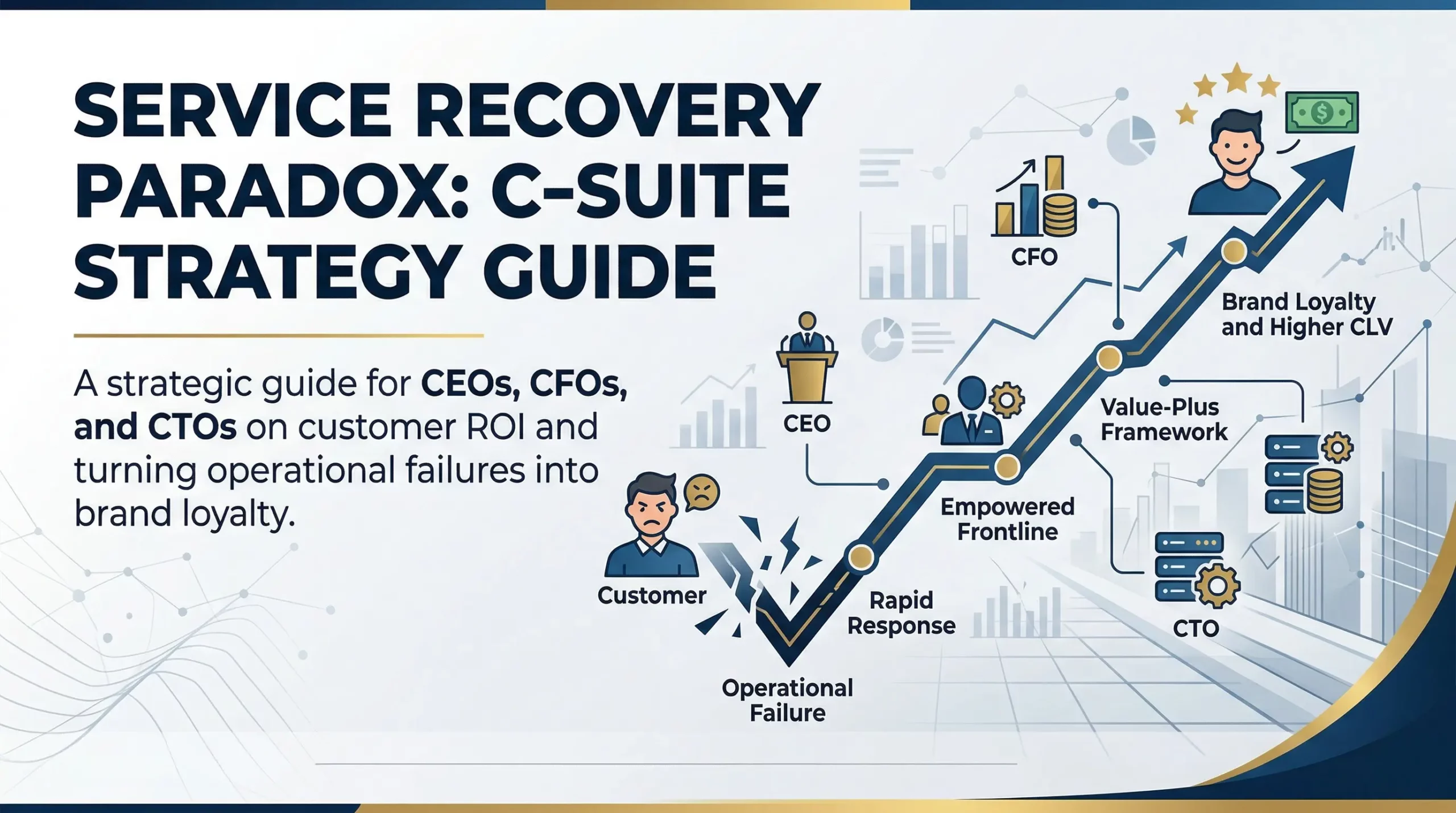
However, top leaders view these failures differently. The true differentiator of a legacy-building firm is not the total absence of errors. Instead, it is the strategic mastery of the Service Recovery Paradox (SRP).
Executives must manage service failures with precision, planning, and deep empathy. As a result, a service failure ceases to be a liability. Instead, it transforms into a high-yield business opportunity. You can engineer deep-seated brand loyalty through a mistake. Indeed, a flawless, routine transaction could never achieve this level of loyalty. This comprehensive guide breaks down the core elements of a successful Service Recovery Paradox business strategy. Thus, top management can turn inevitable mistakes into unmatched competitive advantages.
Leadership must fundamentally understand why the Service Recovery Paradox exists before deploying capital. Therefore, you must move beyond a simple “fix-it” mindset. You must understand behavioral economics and human psychology.
The Service Recovery Paradox is a unique behavioral phenomenon. Specifically, a customer’s post-failure satisfaction actually exceeds their previous loyalty levels. This only happens if the company handles the recovery with exceptional speed, empathy, and unexpected value.
This concept is rooted in the “Expectancy Disconfirmation Paradigm.” Clients sign contracts with your firm expecting a baseline level of competent service. Consequently, when you deliver that service flawlessly, you merely meet expectations. The client’s emotional state remains entirely neutral. After all, they got exactly what they paid for.
However, a service failure breaks this routine. Suddenly, the client becomes hyper-alert, frustrated, and emotionally engaged. You have violated their expectations. Obviously, this is a moment of extreme vulnerability for your brand. Yet, it is also a massive stage. Your company can step onto that stage and execute a heroic recovery. As a result, you completely disconfirm their negative expectations.
You prove your corporate character under intense pressure. Furthermore, this creates a massive emotional surge. It mitigates the client’s perception of future risk. Consequently, you cement a deep bond of operational resilience. To a middle manager, a failure looks like a red cell on a spreadsheet. In contrast, a visionary CEO sees the exact inflection point where a vendor transforms into an irreplaceable partner.
Historically, corporate finance departments viewed customer service as a pure cost center. They heavily scrutinized refunds, discounts, and compensatory freebies as margin-eroding losses. However, forward-thinking CFOs must aggressively reframe this narrative. A robust Service Recovery Paradox business strategy acts as a highly effective churn mitigation strategy. Furthermore, it directly maximizes your Customer Lifetime Value (CLV).
The cost of acquiring a new enterprise client continues to skyrocket year over year. Saturated ad markets and complex B2B sales cycles drive this increase. Therefore, a service failure instantly places a hard-won customer at a churn crossroads.
A mediocre or slow corporate response pushes them toward the exit. Consequently, you suffer the total loss of their projected Customer Lifetime Value. Conversely, a paradox-level recovery resets the CLV clock.
Consider an enterprise SaaS client paying $100,000 annually. First, a server outage costs them an hour of productivity. Offering a standard $11 refund does not fix their emotional frustration. In fact, it insults them. Instead, the CFO should pre-authorize a robust recovery budget. This allows the account manager to immediately offer a free month of a premium add-on feature. This software costs the company very little in marginal expenses. However, the client feels deeply valued. You prove your organization handles crises with generosity. Thus, you actively increase their openness to future upsells. Ultimately, you secure that $100,000 recurring revenue by spending a tiny fraction of acquisition costs.
We operate in an era of instant digital transparency. A single disgruntled B2B client can vent on LinkedIn. Similarly, a vocal consumer can create a viral video about a brand’s failure. As a result, they inflict massive, quantifiable damage on your corporate brand equity.
Conversely, a client experiencing the Service Recovery Paradox frequently becomes your most vocal brand advocate. They do not write reviews about software working perfectly. Instead, they write reviews about a CEO personally emailing them on a Sunday to fix a critical error. This positive earned media significantly reduces your required marketing spend. You establish trust with new prospects much faster. Therefore, your service recovery budget is a high-ROI marketing investment. It actively protects your reputation.
The Service Recovery Paradox presents a complex technical design challenge for the CTO. In the past, IT focused solely on preventing downtime. Today, the mandate has evolved. CTOs must architect systems that recover with unprecedented speed, transparency, and grace.
The psychological window for achieving the paradox closes rapidly. Usually, it closes before a client even submits a formal support ticket. Frustration sets in quickly. Therefore, modern technical leadership must prioritize advanced observability.
Your tech stack must utilize AI-driven sentiment analysis on user interactions. Furthermore, you must monitor API latency and deep system error logs. Your systems must detect user friction before the user feels the full impact. For instance, monitoring tools might flag a failed checkout process or a broken API endpoint. Consequently, the system should instantly alert your high-priority recovery team. Speed remains the ultimate anchor of the paradox. Recovering before the client realizes there is a problem is the holy grail of technical customer service.
You cannot execute a genuine Service Recovery Paradox business strategy manually at a global enterprise scale. Therefore, CTOs should implement automated recovery engines. You must interconnect these engines with your CRM and billing systems.
A system might detect a major failure impacting a specific cohort of clients. Subsequently, it should automatically trigger a compensatory workflow. This could manifest as an instant, automated account credit. Alternatively, it could send a proactive push notification apologizing for the delay. You might even include a highly relevant discount code. Furthermore, an automated email from an executive alias can take full accountability. The technology itself initiates this proactive transparency. As a result, it triggers a profound psychological shift. The client feels seen and prioritized.
Institutional friction usually blocks the Service Recovery Paradox. A lack of good intentions is rarely the problem. A front-line customer success manager might require three levels of executive approval to offer a concession. Consequently, the emotional window for a win disappears entirely. Bureaucratic exhaustion replaces customer delight.
Top management must aggressively dismantle rigid, script-based customer service bureaucracies. Instead, you must pivot toward outcome-based empowerment.
CEOs and CFOs must collaborate to establish a “Recovery Limit.” This represents a pre-approved financial threshold. Front-line agents can deploy this capital instantly to make a situation right. For example, you might authorize a $100 discretionary credit for retail consumers. Likewise, you might authorize a $10,000 service credit for enterprise account managers. Employees must have the authority to pull the trigger without asking permission. Speed is impossible without empowered employees.
A simple refund merely neutralizes the situation. It brings the client back to zero. Therefore, your teams must use the Value-Plus Framework to achieve the paradox.
First, Fix the Problem: You must resolve the original issue immediately. The plumbing must work before you offer champagne.
Second, Apologize Transparently: Say you are sorry without making corporate excuses. Clients do not care about your vendor issues. They care about their business.
Third, Add Real Value: This is the critical “Plus.” You must provide extra value that aligns seamlessly with the client’s goals. For instance, offer an extra month of a premium software tier. Alternatively, provide an unprompted upgrade to expedited overnight logistics.
Human Resources and Operations leaders must foster a specific corporate culture. Otherwise, the organization cannot consistently benefit from the Service Recovery Paradox. You must analyze operational failures scientifically rather than punishing them emotionally.
Executive leadership must lead post-mortems focused entirely on systemic optimization after a major glitch. Sometimes, employees feel their jobs or bonuses are at risk for every mistake. Consequently, human nature dictates they will cover up failures. You cannot recover hidden failures. Thus, fear destroys any chance for a Service Recovery Paradox.
Management must visibly support winning back the customer as the primary goal. Consequently, the team acts with the speed and urgency required to trigger the psychological shift. You should never ask, “Who did this?” Instead, you must ask, “How did our system allow this, and how fast did we recover?”
Artificial intelligence increasingly handles routine technical fixes and basic FAQ inquiries. Therefore, you must reserve human intervention exclusively for high-stakes, high-emotion service failures.
HR leadership must pivot corporate training budgets away from basic software operation. Instead, they must invest heavily in high-level Emotional Intelligence (EQ). Furthermore, teams need advanced conflict de-escalation and empathetic negotiation skills. A client does not want an automated chatbot when a multi-million dollar supply chain breaks. Rather, they want a highly trained, deeply empathetic human being. This person must validate their stress and take absolute ownership of the solution. Ultimately, the human touch turns a cold technical fix into a warm, loyalty-building psychological paradox.
The Service Recovery Paradox remains a formidable, revenue-saving tool in your strategic arsenal. However, executive management must remain hyper-aware of the “Reliability Trap.”
You cannot build a sustainable, long-term business model on apologizing. The paradox has a strict statute of limitations. A customer might experience the exact same failure twice. Consequently, they no longer view the heroic recovery as exceptional. Instead, they view it as empirical evidence of consistent incompetence.
Operational psychologists call this a “Double Deviation.” The company fails at the core service and then fails the overarching trust test. This compounds the frustration and guarantees permanent, unrecoverable churn.
Furthermore, you should never intentionally orchestrate a service failure just to trigger the paradox. It acts as an emergency parachute, not a daily commuting vehicle. It relies heavily on a pre-existing trust reservoir. A brand-new startup with zero market reputation has no reservoir to draw from. Therefore, the client will simply leave. The paradox works best for established leaders. It aligns perfectly with the customer’s existing belief that your company is usually excellent.
The Service Recovery Paradox serves as the ultimate stress test of an organization’s operational maturity. Furthermore, it tests leadership cohesion.
It requires a visionary CFO. This CFO must value long-term Customer Lifetime Value over short-term penny-pinching. Moreover, it requires a brilliant CTO. This technical leader must build self-healing, hyper-observant systems that catch friction instantly. Most importantly, it requires a strong CEO. The CEO must prioritize a culture of radical front-line accountability and psychological safety.
Every competitor promises fast, reliable, and seamless service in today’s commoditized global market. Therefore, the only way to be truly memorable is to handle a crisis vastly better than your peers.
You are simply fulfilling a contract when everything goes right. However, you receive a massive microphone when everything goes wrong. Stop fearing operational failure. Assume it will happen. Then, start aggressively perfecting your operational recovery. That is exactly where you protect the highest profit margins. Furthermore, that is where you forge the most fiercely loyal brand advocates.
How can you supercharge your business with bespoke solutions and products.