
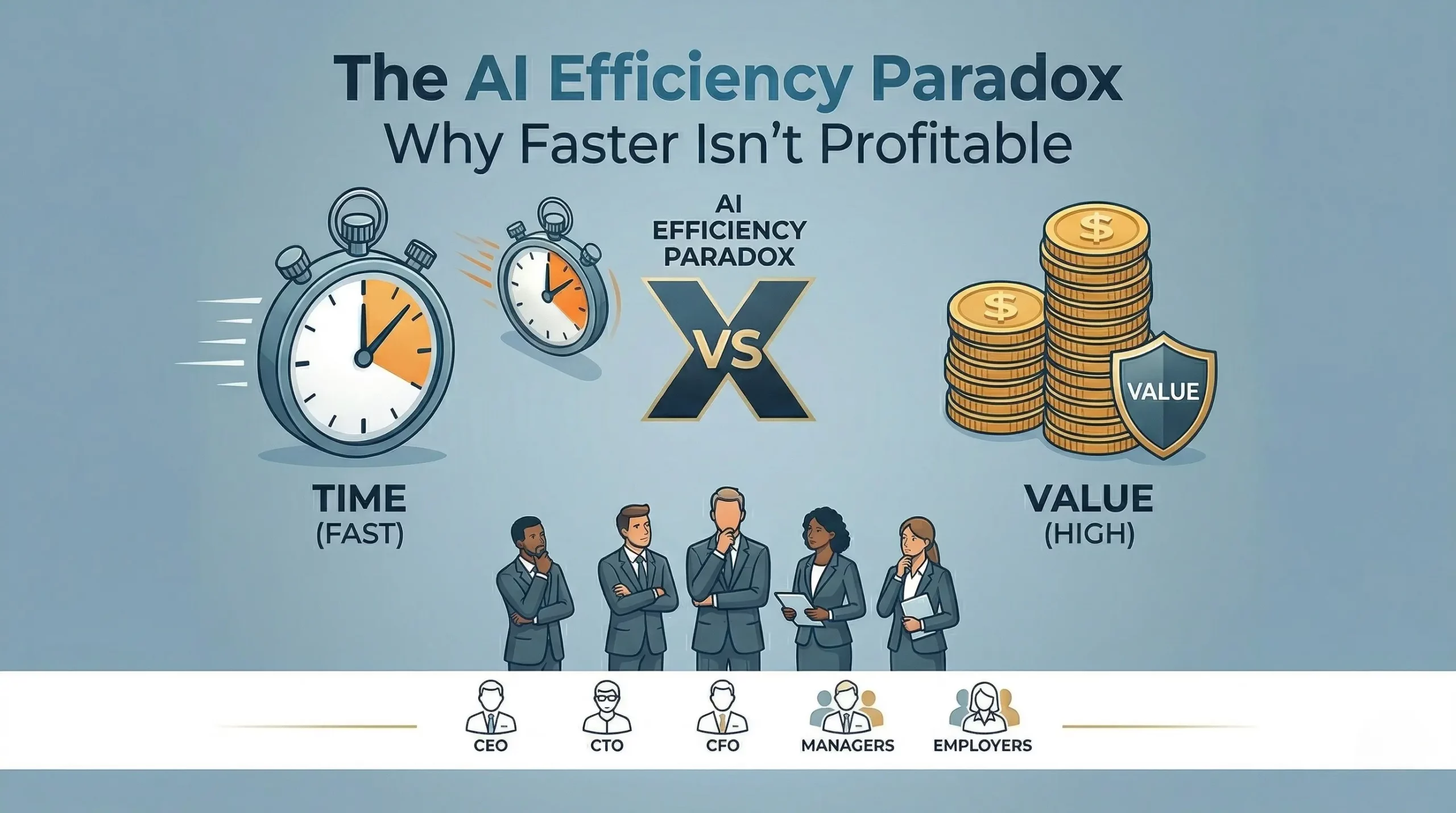
Imagine this scenario: your creative agency has a highly profitable service line. For years, your team has spent roughly six hours drafting, formatting, and finalizing a comprehensive market research report for enterprise clients. You bill this out at $150 an hour. That’s $900 of top-line revenue per report.
Then, your CTO introduces a new generative AI tool. The team is thrilled. Within weeks, they figure out how to feed the raw data into the system, apply a custom prompt, and generate the exact same high-quality report in just six minutes.
Management celebrates. High-fives all around. You just became 60x faster.
But then the invoice goes out. Because you sell your time, you can now only ethically bill the client for a fraction of an hour. Your $900 revenue event just plummeted to $15. You still have the same office lease, the same payroll, and the same overhead—but your revenue has evaporated overnight.
This is the AI efficiency paradox in business. What most people miss is that adopting hyper-efficient technology without simultaneously updating your fundamental business model is a fast track to financial ruin.
If you are a CEO, CTO, or agency owner in 2026, the question is no longer about how to get faster. The real question is how you survive the impact of AI on billable hours. Let’s break down exactly why the traditional professional services model is breaking, and how you can restructure your pricing to turn this paradox into a massive competitive advantage.
Let’s be honest. The professional services industry—marketing agencies, law firms, accounting practices, and consulting groups—has operated on a deeply flawed incentive structure for decades. You sell time. Therefore, inefficiency is technically profitable.
If a junior designer takes five hours to do a task that a senior designer could do in one hour, the agency bills more for the junior’s time. The client pays for the friction.
Enter generative AI. We are now deploying systems designed explicitly to destroy time. When you introduce autonomous agents and advanced LLMs into a time-and-materials business model, you are actively cannibalizing your own margins. According to the Harvard Business Review, the traditional billable hour model is rapidly declining as clients refuse to subsidize manual work that software can execute in seconds.
Here is the catch: your clients know you are using AI. They read the same tech blogs you do. They know that analyzing a massive dataset no longer requires a team of analysts working through the weekend. If you try to hide the speed and continue billing for ghost hours, you will lose their trust. If you bill transparently for the faster time, you lose your profit.
This structural misalignment is exactly why AI transformations fail before they ever reach scale. Companies try to force-fit a revolutionary, time-destroying technology into an evolutionary, time-dependent pricing model. It simply does not compute.
To fully grasp the AI efficiency paradox in business, we need to look at how middle management fundamentally misunderstands the concept of “time saved.”
Software vendors are notorious for selling you on the dream of reclaimed time. The sales pitch is always the same: “Our AI agent will save every employee on your team 10 hours a week!”
The CEO and CFO hear this, multiply 10 hours by 50 employees, multiply that by the average hourly rate, and calculate a massive, phantom ROI. They sign a costly enterprise software contract.
A year later, they review the P&L. They haven’t saved any money. Why? Because time saved is not the same as money earned.
If you save an employee 10 hours a week, but you do not systematically redirect those 10 hours into net-new revenue-generating activities—like upselling existing accounts, closing new business, or expanding service offerings—you haven’t gained anything. You have merely subsidized your team’s free time. Your employees are now doing 30 hours of work, getting paid for 40, and you are footing the bill for the expensive AI software that made it happen.
Before you roll out another tool, you have to establish a clear baseline. You must address the 3-week number change crisis—the phenomenon where companies deploy AI, see a brief spike in vanity metrics, and then watch performance flatline because they never tied the tool to an actual business outcome. Measuring AI profitability requires tracking what happens after the time is saved.
The efficiency paradox hits the CFO’s desk the hardest. Many business leaders mistakenly believe that AI business model disruption is primarily about cost-cutting. They assume that if AI does the work of three junior analysts, they can fire three junior analysts and keep the difference as pure profit.
This is a dangerous oversimplification of AI ROI for professional services.
First, the cost of top-tier AI talent to manage these systems is astronomical. Second, the software itself is not cheap. Forbes recently highlighted that hidden software costs, API usage fees, and enterprise-grade data security add-ons are eating aggressively into the efficiency gains companies thought they were getting.
When you transition to an AI-driven workflow, your variable costs (human labor) decrease, but your fixed costs (software, compute, data infrastructure) increase. If your revenue is shrinking because you are billing fewer hours, and your fixed costs are rising because you are paying for enterprise AI wrappers, your margins will get squeezed from both sides.
The CFO’s nightmare is realizing that the company spent $200,000 on AI infrastructure to solve tasks 90% faster, only to discover that the clients are now demanding a 90% discount on the deliverables.
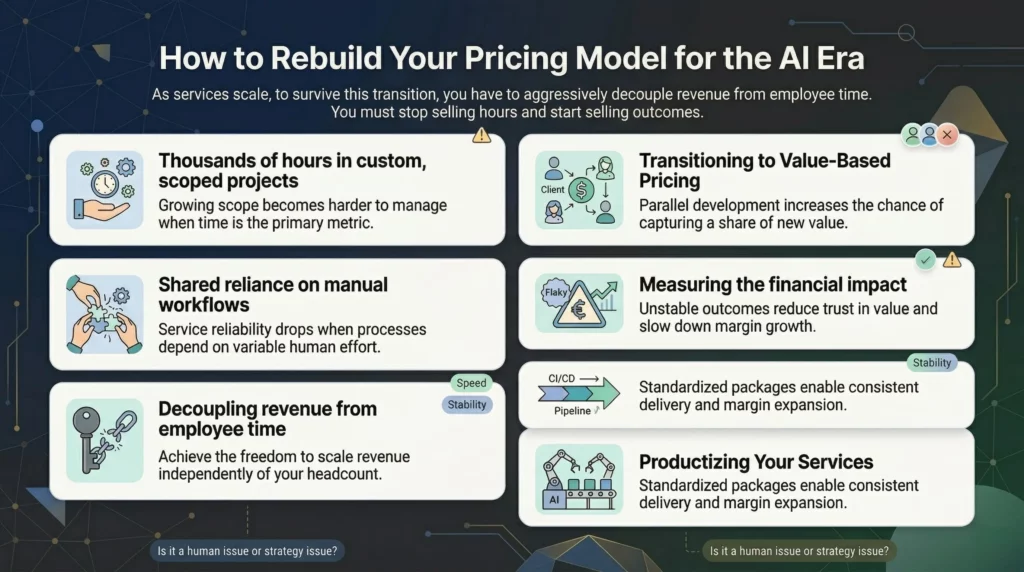
If you want to survive this transition, you have to aggressively decouple your revenue from your employees’ time. You must stop selling hours and start selling outcomes.
Value-based pricing means you charge the client based on the financial impact of the work, not the time it took to create it.
If you build an automated lead-scoring model for a client that increases their sales conversion rate by 15% and nets them $1 million in new revenue, the value of that outcome is massive. It does not matter if your AI tools allowed your team to build that model in three days instead of three months. You do not charge them for three days of labor. You charge them a flat $100,000 for the $1 million outcome.
McKinsey’s frameworks on tech-enabled services clearly indicate that companies transitioning to value-based pricing capture significantly higher margins during technological shifts. The client doesn’t care how hard you worked; they care about the result.
The ultimate agency growth strategy 2026 involves turning your services into scalable products.
Instead of scoping out a custom, hourly contract for every new client, create standardized packages. For example: “We will run a complete competitive SEO audit, produce a 12-month content roadmap, and deliver an automated reporting dashboard for a flat fee of $15,000.”
Behind the scenes, your margins are dictated by how efficiently you can deliver that exact product. If your team manually grinds it out, your margin is 20%. If your team uses AI agents to execute 80% of the heavy lifting, your margin jumps to 85%.
By productizing, the AI efficiency paradox in business works for you, not against you. The faster you get, the more profitable you become, because the client’s price remains locked to the value of the final deliverable.
Transitioning an entire organization from hourly billing to value-based pricing is terrifying for middle managers. They have spent their entire careers managing capacity and tracking utilization rates.
If an employee’s utilization rate drops from 90% to 40% because AI is doing half their job, a traditional manager will panic. The CEO and CTO must step in and change the KPIs.
You need to shift your best people to the most boring problems—the repetitive, data-heavy tasks that eat up margins—and automate them entirely. Then, take the human brainpower you just freed up and point it at complex strategy, relationship building, and high-judgment decision making.
Furthermore, CTOs must ensure that speed does not compromise quality. When agents generate deliverables in seconds, the risk of factual errors skyrockets. If your agency delivers a strategic report containing an entity hallucination in AI, you will lose the client entirely. The focus of management must shift from managing how long something takes to strictly managing how accurate and valuable it is.
AI shouldn’t make your business cheaper; it should make your business infinitely more scalable.
The AI efficiency paradox in business is only a threat to leaders who insist on clinging to outdated models. The agencies and professional services firms that dominate the next decade will not be the ones who hold onto the billable hour. They will be the ones who realize that AI is fundamentally a margin-expanding technology, provided you have the courage to change how you bill for your expertise.
Stop selling the time it takes to dig the hole. Start selling the hole. Realign your pricing, demand harder metrics, and let the machines do the heavy lifting.
How can you supercharge your business with bespoke solutions and products.