
Your AI strategy may look strong on paper. The roadmap is approved, the tools are selected, and the automation goals are clear. But if your CRM, ERP, finance dashboard, and operations systems all show different answers, your AI strategy is already standing on unstable ground.
This is the real danger of multiple versions of truth. It is not just a reporting problem or a data hygiene issue. It is a business risk that directly affects decision-making, AI readiness, and the ability to scale automation with confidence. Before companies ask what AI can do for them, they need to ask a more basic question: can our data be trusted?
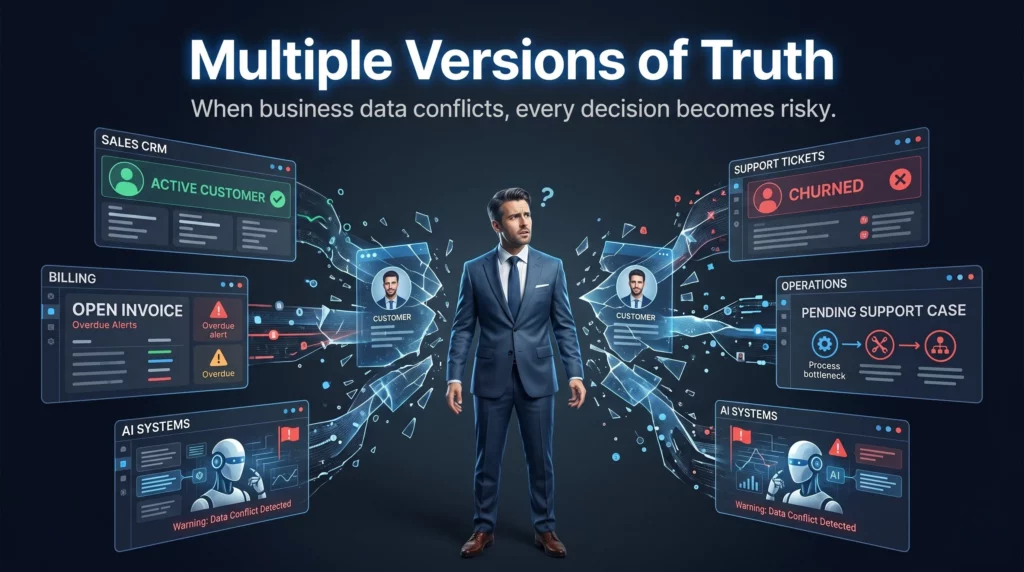
The phrase “multiple versions of truth” sounds technical, but the reality is painfully simple. It means different parts of your organization are working from different datasets that contradict each other.
Your sales team calls a customer “active.” Your support team has them marked “churned.” Your billing system still has an open invoice. Which version is real? Honestly, none of them are fully right.
This happens for a few reasons. Data silos are a big one. When departments build their own spreadsheets, maintain their own CRM records, and create their own reporting dashboards without a shared data governance framework, you end up with fragmented truths that slowly pull your operations apart.
Conflicting data is not always caused by careless teams. Often it comes from legacy systems that were never designed to talk to each other, manual data entry that introduces small errors over time, or integration gaps where two platforms sync inconsistently. The result is the same regardless of the cause: your decisions, your workflows, and your AI agents are all working from unreliable ground.
If you want to understand how scattered information creates this problem from the roots up, this deeper look at why scattered knowledge is silently sabotaging your AI is worth your time.
Here is the catch that most AI implementation guides skip over. AI agents are only as reliable as the data they are trained on or given access to. When you feed conflicting data into an AI system, you are not just getting imperfect outputs. You are actively teaching the system to trust bad information.
Think about what an AI agent actually does. It reads your data, identifies patterns, makes decisions, and triggers actions. If the customer record says one thing and the billing record says another, the AI will either pick one arbitrarily, get confused and fail, or worse, act on the wrong version and create a downstream problem you do not catch for weeks.
This is one of the main reasons AI automation projects underdeliver. It is rarely the AI model itself that fails. It is the data infrastructure underneath it.
According to a McKinsey report on AI adoption, one of the top barriers to scaling AI across enterprises is not the technology itself but the quality and consistency of the underlying data. Companies that manage to solve their data consistency problems before deploying AI see significantly better results from their investments.
The issue is especially sharp when you consider real-time operations. If an AI agent is making decisions based on data that is stale, duplicated, or in conflict with another system, it is essentially flying blind. We explored this problem in detail when looking at why real-time data access is the hidden reason your AI agents are failing.
Target’s expansion into Canada is one of the most well-documented data management failures in retail history. When Target opened 133 Canadian stores in 2013, they migrated enormous amounts of product data into their new SAP system. The problem was that the data was riddled with errors and inconsistencies.
Product dimensions were wrong. Descriptions did not match. Cost data had thousands of inaccuracies. The system was receiving one version of truth from suppliers, another from logistics partners, and another from internal teams. Nobody could agree on what was correct.
The result was catastrophic. Shelves were either completely empty or massively overstocked. Customers came in expecting products they had seen advertised and left empty-handed. Inventory systems showed items as available that simply were not there.
Target Canada shut down entirely in 2015, just two years after opening. The losses totaled over $2 billion. A Harvard Business Review analysis of the failure pointed directly at data quality and management failures as a root cause. The IT and logistics systems could not function because the foundational data was too inconsistent to support reliable operations.
The lesson here is brutal but clear. No operational system, and certainly no AI system, can compensate for broken data at the source. Multiple versions of truth do not just create reporting headaches. They bring entire business operations to a halt.
Source: Harvard Business Review, “How Target Lost Canada”
Data silos are where multiple versions of truth are born. When your marketing team uses HubSpot, your finance team uses a different system, your operations team has a custom database, and your customer service team is still running on spreadsheets, you are not building one picture of your business. You are building four separate pictures that often contradict each other.
Gartner research has consistently highlighted that organizations with poor master data management are significantly less effective at digital transformation. The reason is straightforward: transformation requires coordination, and coordination requires agreement on what is true.
Here is what makes data silos particularly dangerous for AI readiness. AI agents are designed to work across functions. They need to pull customer data, check inventory, verify pricing, confirm approvals, and trigger actions across multiple systems in a single workflow. If every system has its own version of the facts, the AI cannot string those steps together reliably.
This also ties directly into the documentation problem. When processes live in people’s heads or in outdated wikis rather than in a consistent, maintained system of record, AI agents cannot follow them. We covered that specific problem in our analysis of why undocumented workflows stop AI agents from automating your business.
A single source of truth is not a single database. That is a common misunderstanding. It is a principle, not a piece of software. It means that for any given data point, there is one authoritative place where that data lives and is maintained. Every other system either refers to it or syncs from it.
Getting there requires a few foundational things.
First, you need data governance. That means deciding who owns each data type, who has permission to edit it, and what the process is for resolving conflicts when they appear. Without ownership, you get competing versions with no referee.
Second, you need integration architecture that maintains consistency. If two systems need to share customer data, they should sync from one master record rather than each maintaining their own copy. Real-time syncing with conflict resolution rules is what separates clean data environments from messy ones.
Third, you need audit trails. When a piece of data changes, you need to know who changed it, when, and why. This is not just good governance. It is essential for AI accountability, especially as AI agents start making decisions based on that data.
If you have already deployed AI agents and are starting to see inconsistent outputs, conflicting data is almost certainly part of the problem. You can read more about how this connects to broader AI readiness challenges in our piece on scattered knowledge and AI agents readiness.
Let us get specific for a moment because this matters for anyone actively building or buying AI automation.
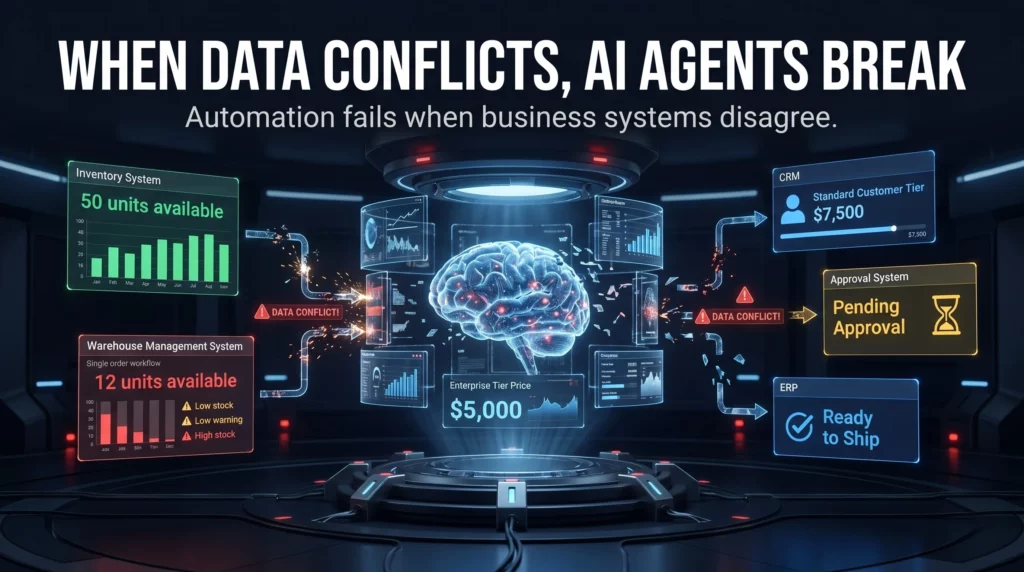
An AI agent handling order management needs to know the current stock level, the correct product specifications, the right pricing for the customer tier, and the approval status of the order. If your inventory system says 50 units are available but your warehouse management system says 12, the AI agent will either order too much, confirm availability it cannot deliver on, or stop entirely because it cannot reconcile the conflict.
This is not a theoretical problem. It is why so many AI pilots perform beautifully in a controlled demo environment and then fall apart when exposed to real company data. The demo uses clean, consistent test data. The production environment has five years of accumulated inconsistencies.
The same dynamic plays out in customer service AI, financial reporting agents, HR workflow automation, and supply chain management. The technology is ready. The data often is not.
We also explored a related dimension of this in our article on why AI agents fail when your documentation lies. Documentation inconsistency and data inconsistency are two sides of the same problem.
You do not need to rebuild your entire data infrastructure overnight. Here is a realistic starting point.
Start with a data audit. Map out where your most critical data lives. Customer records, product data, financial figures, and operational metrics. Identify where the same data exists in multiple places and flag any known discrepancies.
Assign data ownership. For each critical data type, designate one team or individual as the authoritative owner. They are responsible for accuracy and for resolving conflicts.
Establish a master data record. Pick one system as the source of truth for each data category. All other systems should sync from it, not maintain independent copies.
Build conflict resolution rules. When data discrepancies are detected, have a documented process for how they get resolved. This is especially important for AI systems, which need clear logic to follow rather than human judgment calls.
Test before you automate. Before deploying AI agents into any workflow, validate the data quality they will depend on. A short data quality assessment upfront saves weeks of troubleshooting later.
For organizations that are actively preparing for AI agent deployment, this aligns closely with the broader readiness framework we discuss in our guide on multiple versions of truth and why conflicting data kills your AI.
Here is an honest question worth sitting with. If your AI agent made a major business decision today based entirely on your current data, would you be comfortable with that?
If the answer is anything other than a clear yes, you have a data consistency problem worth addressing before you go any further with AI automation.
Multiple versions of truth are not just a technical issue. They are a trust issue. Your teams stop trusting reports because they have seen conflicting numbers too many times. Decisions slow down because nobody is confident in the baseline. And AI agents cannot step in to fix this because they rely on the same broken data to operate.
The companies that are getting real returns from AI right now have one thing in common. They sorted out their data foundations first. They did the unglamorous work of data governance, integration, and master data management before they went looking for the exciting AI use cases.
That is not a coincidence.
If you want to go deeper on what AI agents actually need from your data environment before they can operate reliably, our breakdown of why AI agents fail without real-time data access is a good next read. And if you are thinking about how approvals and review layers interact with your data quality problem, we have covered that too in our piece on AI agents and the missing approval layer.
Clean data is not the most exciting part of an AI strategy. But it is the part that determines whether the rest of it works.
How can you supercharge your business with bespoke solutions and products.