
Your firewall works. Your access controls look clean. Your IT team passed the last compliance audit without a single flag. So why does your AI agent keep doing things it was never supposed to do?
Here’s the catch. Most enterprise security models were designed with one assumption at the center: a human is always in the loop. Someone logs in. Another person requests access. A manager approves a transaction. Every control, every audit trail, and every permission layer centers on the idea that a person is making the decision.
AI agents do not work that way.
When you introduce autonomous AI agents into your workflows, you are not just adding a new tool. You are introducing a new type of actor into your systems — one that operates continuously, makes decisions at machine speed, and does not wait for someone to click “approve.” If your security model has not kept up, you are running a powerful autonomous system through a framework that was never built to contain it.
This is one of the most overlooked risks in enterprise AI adoption today. And it is silently growing in organizations that believe they are ready for AI agents when, in reality, they are only ready for AI tools that humans control.
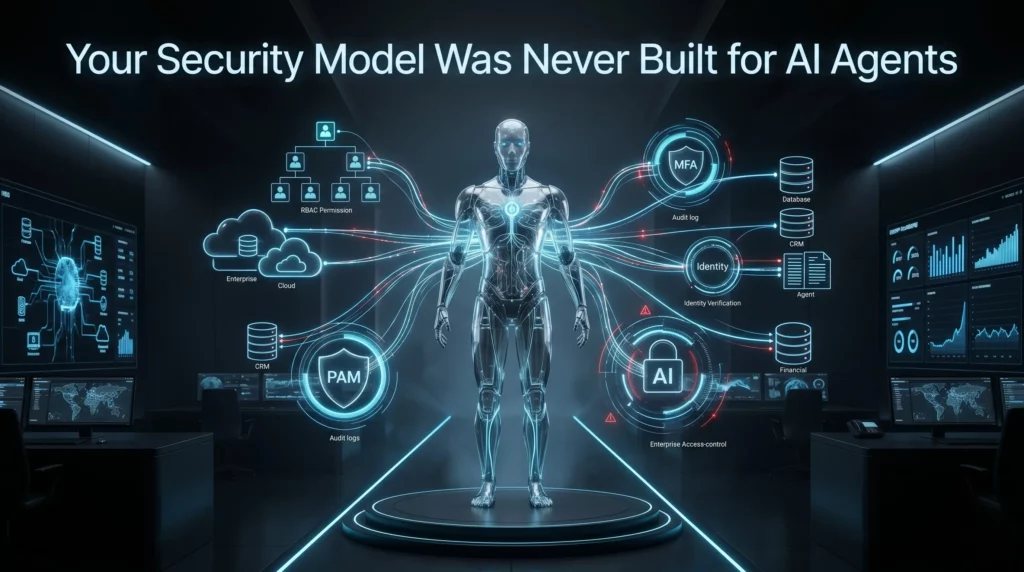
Traditional enterprise security is built on a few foundational ideas. Role-based access control (RBAC) gives specific users specific permissions. Multi-factor authentication (MFA) verifies identity at login. Audit logs track which employee took which action. Privileged access management (PAM) ensures only authorized people can access sensitive systems.
Every single one of these controls assumes a human being is the actor.
When an AI agent enters the picture, it does not log in the way an employee does. There is no ticketing system request. Instead, it operates across dozens of tools and data sources simultaneously, making hundreds of micro-decisions in the time it takes a human to read one email. Furthermore, because teams typically gave it broad permissions during setup to work efficiently, it often has access to far more than it actually needs for any single task.
This is what security built only for humans looks like when it meets AI: the agent operates under a user account or service account, inheriting whatever permissions that account holds. There is no granular control over what the agent can actually do versus what the account technically allows. Nobody built a system to monitor autonomous action at the speed AI operates.
If you have also not addressed issues like scattered knowledge across tools and teams, your AI agent may be accessing data from systems it never should have touched in the first place, simply because nobody ever tightened permissions to match task-specific needs.
Let’s be honest about the gap here. Traditional security controls fail AI agents for three concrete reasons.
First, there is no identity model for autonomous actors. Your security infrastructure knows how to handle Bob from finance. It does not know how to handle an AI agent that is simultaneously querying your CRM, drafting emails, updating records, and sending Slack messages, all without a human in the loop at any step. The agent lacks a distinct identity with its own purpose-built constraints.
Second, access is too broad by design. AI agents need access to function. In the rush to get them operational, teams frequently give agents overly permissive service accounts because it is faster than building granular controls. The result is an autonomous system with access to data and actions far beyond what its actual tasks require. Security researchers call this the principle of least privilege failure — and it is rampant in early AI deployments.
Third, traditional monitoring cannot keep pace with autonomous action. Your SIEM (Security Information and Event Management) system is excellent at flagging unusual human behavior. However, it cannot distinguish between an AI agent doing its job correctly and an AI agent doing something it should not. When agents operate at machine speed, by the time a human reviews the logs, the damage may already be done.
This connects directly to a point worth noting: if your organization is also running without a proper approval or review layer for AI decisions, you are compounding the risk substantially. Two missing layers — security and oversight — do not just add up. They multiply.
Most security conversations about AI agents focus on external threats: prompt injection attacks, adversarial inputs, data poisoning. Those are real and worth addressing. However, the more immediate risk for most organizations is internal and architectural.
When an AI agent inherits broad access and no behavioral guardrails, a few scenarios become dangerously plausible. For example, the agent accesses and transmits data to external tools or APIs it was configured to work with, but nobody reviewed whether those integrations were appropriate for the sensitivity of that data. In addition, the agent takes actions in connected systems based on decisions rooted in multiple conflicting versions of the same data, producing outputs that are technically authorized but factually wrong. Or the agent, following its instructions correctly, triggers a cascade of automated actions across systems that no human would have approved if they had been paying attention.
None of these scenarios require a hacker. They are entirely self-inflicted.
Consequently, there is also the compliance dimension to consider. In regulated industries — healthcare, finance, legal — every data access and every decision needs to be traceable and defensible. An AI agent operating through a general service account with no dedicated audit trail is an audit disaster waiting to happen.
Moreover, for organizations where undocumented workflows still live inside people’s heads, this risk is even higher. An AI agent cannot follow a process that was never formalized, and the resulting improvisations under insufficient security controls can expose data in ways nobody anticipated.
The data on AI security failures is starting to come in, and it is not reassuring.
To begin with, according to IBM’s Cost of a Data Breach Report 2024, the average cost of a data breach reached $4.88 million, a 10% increase from 2023 and the highest figure IBM has recorded. IBM also found that organizations using AI extensively in security operations detected and contained breaches significantly faster, showing how modern security automation can reduce breach impact and response delays. Source: IBM Cost of a Data Breach Report 2024
Additionally, Gartner predicts that by 2028, 25% of enterprise GenAI applications will experience at least five minor security incidents per year, up from just 9% in 2025, as agentic AI adoption and immature security practices continue to expand the attack surface. Source: Gartner, April 2026
Perhaps most striking, a Cloud Security Alliance and Oasis Security survey found that 78% of organizations do not have documented and formally adopted policies for creating or removing AI identities — meaning most enterprises cannot even account for the non-human actors already operating inside their systems. Source: Cloud Security Alliance, January 2026
Taken together, these are not edge cases. They represent the mainstream trajectory of AI adoption without a matching evolution in security thinking.
Company: Samsung Electronics
What happened: In early 2023, Samsung engineers began using ChatGPT to assist with internal code review and debugging tasks. Within weeks, three separate incidents of sensitive data leakage occurred. In one case, an employee submitted proprietary source code to ChatGPT for review. In other reported cases, employees shared internal meeting content and proprietary technical information with AI tools.
None of this was the result of malicious intent. It was the direct result of employees using an AI tool with no security guardrails, no defined boundaries around data sharing with external AI systems, and no access control layer between sensitive internal data and the AI processing it.
Key outcome: Samsung banned internal ChatGPT use shortly after and began developing its own internal AI tools with security controls built in. Samsung was concerned that sensitive data sent to external AI platforms would be difficult to retrieve or delete once uploaded, creating a long-term confidentiality risk with no reliable remediation path.
Why this matters for AI agents: Samsung’s engineers were using AI as a tool they manually interacted with. AI agents operate autonomously. If a manually operated AI tool caused this scale of exposure, an autonomous agent with broad data access and no behavioral guardrails represents a fundamentally larger risk profile.
Verified Sources: The Verge, “Samsung bans employee use of AI tools like ChatGPT after data leak” — theverge.com/2023/5/2/23707796/samsung-chatgpt-ban | AI Incident Database, Incident 768 — incidentdatabase.ai/cite/768
Building security for AI agents is not about replacing your existing framework. Rather, it is about extending it to account for a new type of actor. Here is what that means in practice.
Dedicated identity for every AI agent. Each agent should have its own service identity with purpose-built permissions scoped only to what that agent needs for its specific tasks. Not a shared service account. Not a borrowed user account. Its own identity with its own access log.
Behavioral monitoring, not just access monitoring. You need systems that track what the agent actually does, not just whether it had permission to do it. Specifically, monitoring for anomalous sequences of actions, unusual data volumes, or patterns that deviate from the agent’s defined task scope are all critical.
Data classification and agent access tiers. Not every agent should have access to every data tier. As a result, you need explicit rules around what categories of data each agent can interact with, enforced at the infrastructure level, not just through configuration trust.
Defined operational boundaries. As we have explored in the context of real-time data access and AI agents, agents need to know what systems they are allowed to touch, in what sequence, and under what conditions. These are not just workflow guidelines. They are security boundaries.
Human escalation triggers. For high-stakes or sensitive actions, agents should be configured to pause and escalate to a human decision-maker rather than proceed autonomously. This is not a weakness in your AI strategy. In fact, it is a mature, defensible design choice.
You do not need to rebuild your entire security architecture before deploying AI agents. However, you do need to move deliberately through a few foundational steps.
Start by auditing every AI agent’s current access permissions. Document what each agent can touch, what it actually touches during normal operation, and where those overlap. The difference between “can access” and “needs access” is where your immediate risk lives.
Next, establish a dedicated identity management practice for non-human actors. Many organizations already have frameworks for managing service accounts. Therefore, extend and formalize this for AI agents specifically, giving each agent its own identity and its own audit trail.
Then define and document what actions are in scope for each agent. This connects directly to the broader challenge of making your documentation reflect how work actually gets done. An agent operating against undocumented process boundaries is a security problem as much as an operational one.
Finally, integrate agent behavior monitoring into your existing SIEM or observability stack. That way, you have a single view of what your human and non-human actors are doing, with alerting configured for patterns that deviate from expected task behavior.
The organizations that get AI agents right over the next two years will not be the ones with the most powerful models. They will be the ones that built the right foundations before scaling.
Security built only for humans is not a small gap to patch. It is a structural mismatch between your risk environment and your risk controls. AI agents are already operating in enterprises that were never designed to contain them, and the incidents that result are increasing in both frequency and cost.
The good news is that the path forward is clear. Treat AI agents as distinct actors that need their own identity, their own access controls, and their own behavioral monitoring. Build boundaries that are enforced, not assumed. And do not confuse “no incident yet” with “no risk.”
If you are mapping out AI agent readiness for your organization, it helps to look at these issues together. From why scattered knowledge silently limits AI performance to the structural reasons real-time data access shapes AI agent reliability, security is one piece of a larger picture.
Ready to evaluate where your security model stands for AI agents?
Connect with the Ysquare Technology team on LinkedIn to start that conversation.
How can you supercharge your business with bespoke solutions and products.