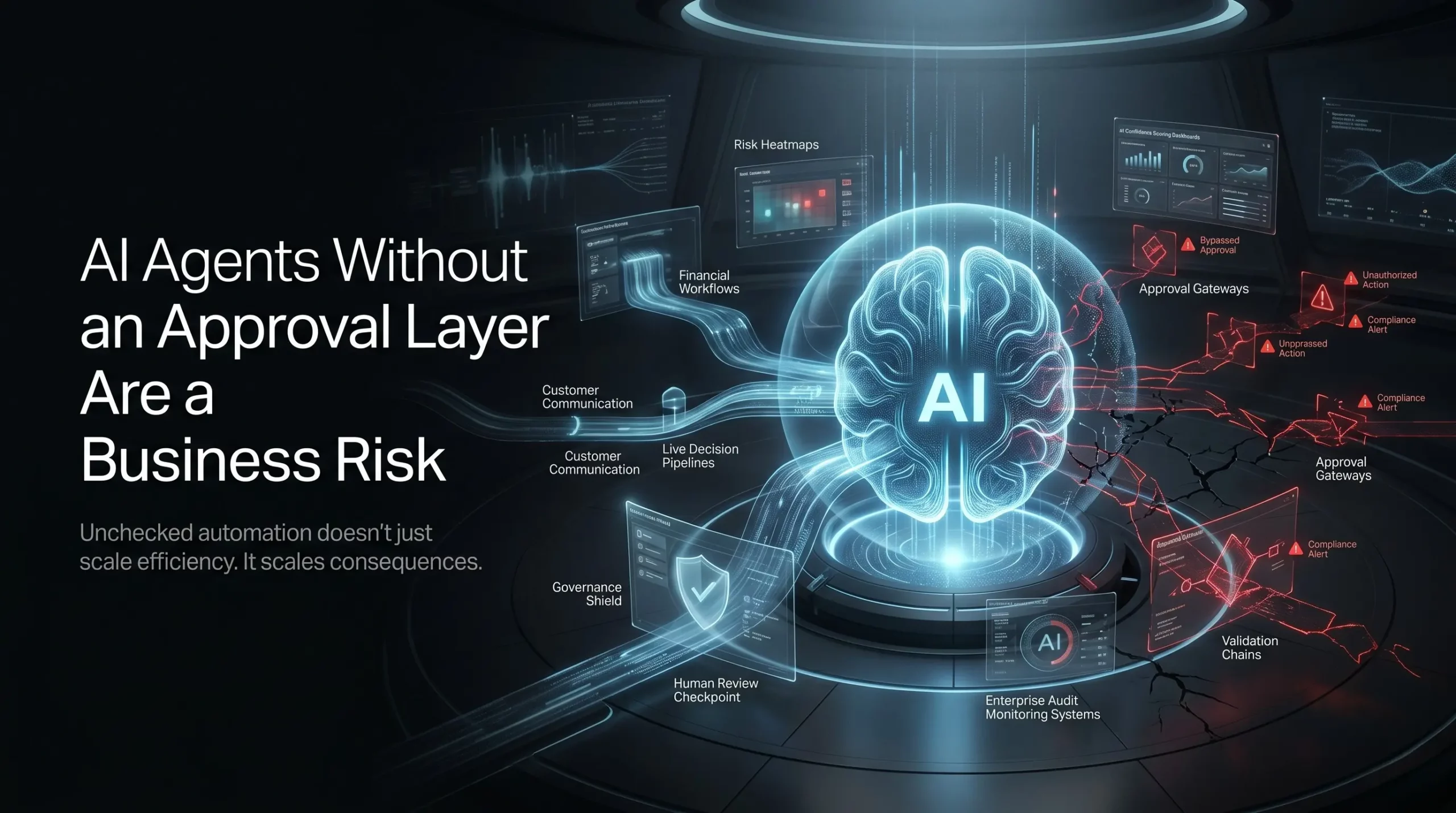
You’ve deployed AI agents. They’re running workflows, responding to customers, processing data, and making decisions around the clock. Sounds like progress.
But here’s the question most leaders don’t ask until it’s too late: who is checking what those agents actually do?
If the answer is “nobody” or worse, “the agent itself” you have a problem that is quietly compounding every single day.
No approval or review layer is one of the most dangerous gaps in any AI deployment. It’s not a technical flaw. It’s a governance failure. And unlike a bug you can patch overnight, the damage it causes often spreads across customer relationships, compliance records, and business data long before anyone notices.
Let’s break down exactly what this means, why it matters, and what you can do about it.
An approval and review layer is a structured checkpoint — built into your AI agent’s workflow — that pauses, flags, or routes outputs before they become actions.
Without it, the process looks like this:
Input → AI processing → Output → Immediate action
No pause. No validation. No human judgment applied at any point in the chain.
That might seem efficient. In reality, it means every hallucination, misinterpretation, and policy error your agent produces goes straight into your operations — into your customer communications, your databases, your financial processes — without a single filter between the mistake and the consequence.
AI agents are powerful precisely because they move fast and operate at scale. But speed without oversight doesn’t make your business faster. It makes your errors faster.
This issue also doesn’t exist in isolation. If your agents are already working from scattered knowledge spread across disconnected systems, or relying on undocumented workflows that live only in your team’s heads, removing the review layer from an already fragile foundation is like removing the brakes from a vehicle you’re not entirely sure is steering correctly.
Here’s what most people miss: the risk isn’t a single catastrophic failure. It’s thousands of small, compounding errors that no one catches because no system is looking for them.
A human employee who makes a mistake gets corrected within hours. Their manager notices, the process adapts, and the scope of damage is contained. An AI agent running flawed logic makes the same mistake on every interaction every transaction, every customer response, every data entry until someone happens to investigate.
By that point, the error isn’t a mistake. It’s a pattern baked into your operations.
The consequences tend to cluster around three areas:
Customer trust: Incorrect information delivered confidently at scale damages your brand in ways that are very hard to walk back. Customers don’t distinguish between “the AI got it wrong” and “the company got it wrong.”
Compliance exposure: Regulators don’t accept “the agent did it” as a defense. If your AI is making decisions in areas governed by financial, healthcare, or data privacy regulations, the absence of human oversight is a liability not a technical footnote.
Data integrity: AI agents connected to live systems can write bad data into records, trigger incorrect downstream processes, and corrupt operational data that other teams and systems depend on. Without a review layer, that contamination spreads silently.
Company: Air Canada What happened:
In November 2022, a customer named Jake Moffatt visited Air Canada’s website after the death of his grandmother. He interacted with the airline’s AI-powered chatbot and asked about bereavement fares. The chatbot told him he could purchase a full-price ticket now and apply retroactively for a bereavement discount within 90 days of purchase. He followed that advice, bought the ticket, and submitted the refund request.
Air Canada denied the claim. Their actual policy didn’t permit retroactive bereavement fare applications. When challenged, the airline argued the chatbot was effectively a “separate legal entity” responsible for its own outputs not a position the court found remotely credible.
Key Outcome:
On February 14, 2024, British Columbia’s Civil Resolution Tribunal ruled against Air Canada in Moffatt v. Air Canada (2024 BCCRT 149). The airline was ordered to pay compensation. The tribunal stated plainly: “the chatbot is still just a part of Air Canada’s website.” The company could not distance itself from what its own AI said to a paying customer.
Shortly after the ruling, the chatbot was removed from Air Canada’s website entirely.
The governance failure:
The chatbot produced an answer that contradicted documented company policy. There was no review mechanism to catch that contradiction before it reached the customer. One incorrect AI output created a legal case, a public relations problem, and a forced product shutdown all of which were entirely preventable with a simple validation layer.
Source: Moffatt v. Air Canada, 2024 BCCRT 149 — McCarthy.ca
This isn’t an isolated incident. The pattern is consistent and well-documented.
Stanford’s 2025 AI Index recorded 233 AI-related incidents in 2024 — a 56% increase from the previous year. A significant proportion of those incidents involved autonomous AI outputs that weren’t reviewed before they caused harm.
Gartner predicts that over 40% of agentic AI projects will be cancelled before reaching maturity by the end of 2027, with poor governance structures including the absence of review checkpoints identified as the primary driver of failure.
McKinsey research found that 80% of organizations have already encountered risky AI agent behaviours in production, including unauthorized data access and incorrect outputs at scale. Most of those organizations lacked a formal review process at the time.
The organizations extracting measurable value from AI aren’t the ones deploying fastest. They’re the ones building oversight infrastructure that makes their agents trustworthy enough to operate at scale.
A related problem compounds this further. When agents work with conflicting data from multiple sources of truth, or without access to real-time information that reflects current conditions, the error rate climbs — and the urgency of a review layer increases proportionally.
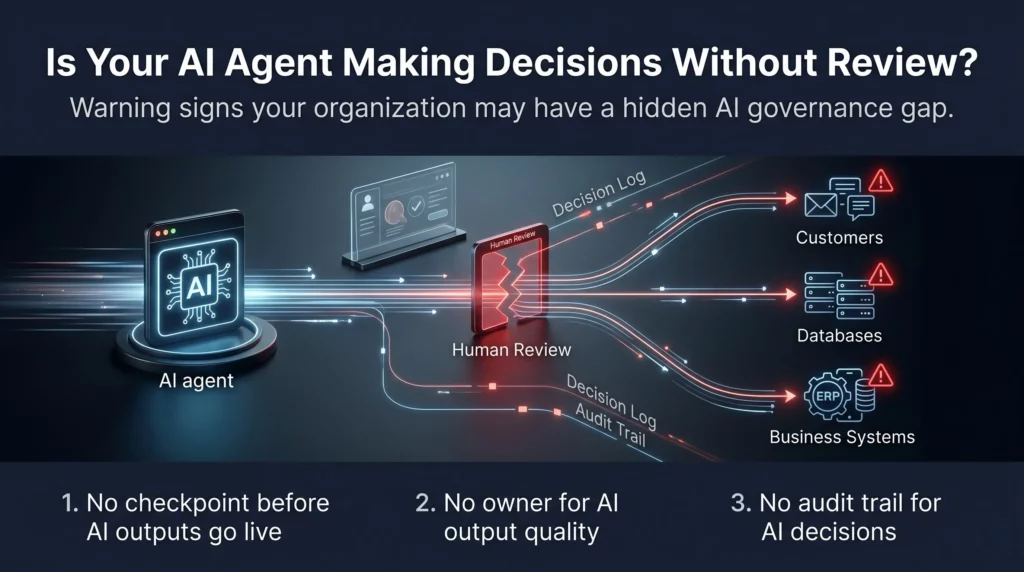
You don’t always need a tribunal ruling to identify this gap. These are the practical warning signs:
If several of those describe your current setup, you’re not in a minority. But you are in a position where one poorly-timed error could become a very public problem.
Adding oversight to your AI workflows doesn’t mean hiring people to manually read every output. It means designing governance that’s proportional to risk.
Not every AI decision carries the same exposure. Map your agent’s outputs into three tiers:
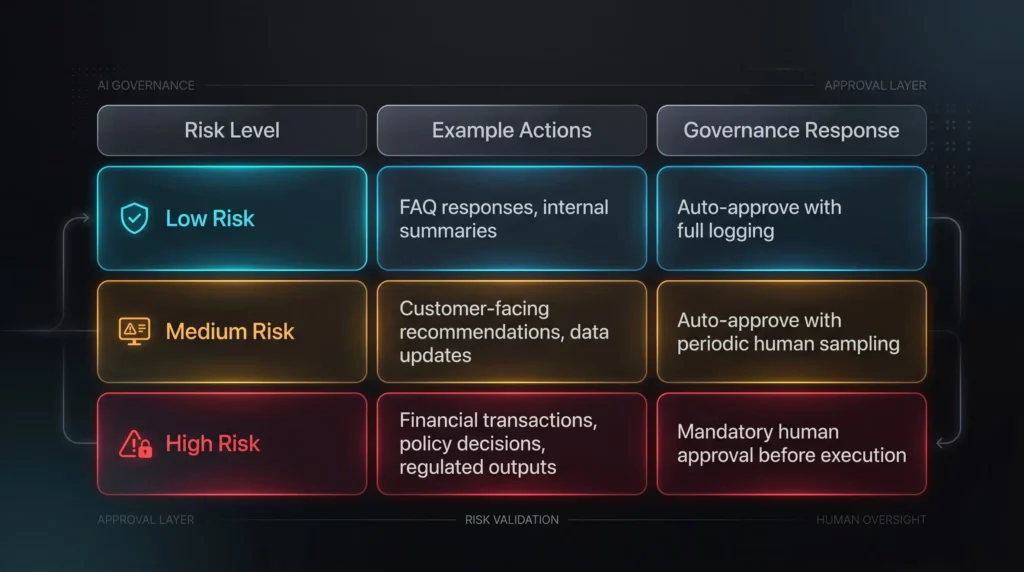
This structure lets your agents move fast on routine decisions while adding friction exactly where the stakes are highest.
Define the conditions that trigger a review — before a human needs to catch it manually:
When those conditions are met, the output routes to a review queue. The agent continues with everything else. You keep the efficiency. You add the accountability.
There’s an important distinction here. A transaction log tells you what your agent did. A governance record tells you why it was authorized to do it — under which rules, with what input, at what confidence level, and who or what validated the decision.
When regulators, auditors, or customers ask why something happened, they’re asking for the governance record. Most organizations currently only have the log. That gap matters.
Someone in your organization needs to own AI output quality. Not as a side responsibility attached to a developer’s role — as a defined accountability. If an agent makes an error, someone should be the person who answers for it internally. That clarity drives better governance design from the start.
According to Cleanlab’s 2025 AI Agents in Production report, regulated enterprises the organizations that have been forced to think carefully about AI oversight are outperforming their unregulated peers on reliability, adoption, and measurable ROI. They’re not slower because of their governance structures. They’re more trusted, which means their teams use the tools more, which means they extract more value.
The insight here isn’t that oversight slows AI down. It’s that oversight is what allows organizations to trust their AI enough to actually expand its use. Agents without review layers don’t just create legal exposure they create institutional hesitancy. Teams who’ve seen an AI error cause a problem become cautious about relying on AI at all.
If your documentation doesn’t accurately reflect how your processes actually work, a review layer also helps your team catch the gaps that feed bad outputs in the first place — turning each flagged error into a learning signal rather than just a cost.
AI agents are not inherently risky. Unchecked AI agents are.
The difference between a deployment that builds trust and one that creates liability isn’t the sophistication of the model. It’s whether someone or some system is verifying what the agent does before the consequences are irreversible.
The organizations winning with AI right now are the ones who understood early that governance isn’t a constraint on performance. It’s the foundation of it.
If you’re deploying agents without an approval and review layer, you’re not moving faster than your competitors. You’re accumulating risk that will eventually surface as a cost.
At Ysquare Technology, we help enterprise leaders design and deploy AI agent systems built for real-world operations — with the governance, oversight, and accountability structures that scale without breaking.
Explore more in this series:
How can you supercharge your business with bespoke solutions and products.