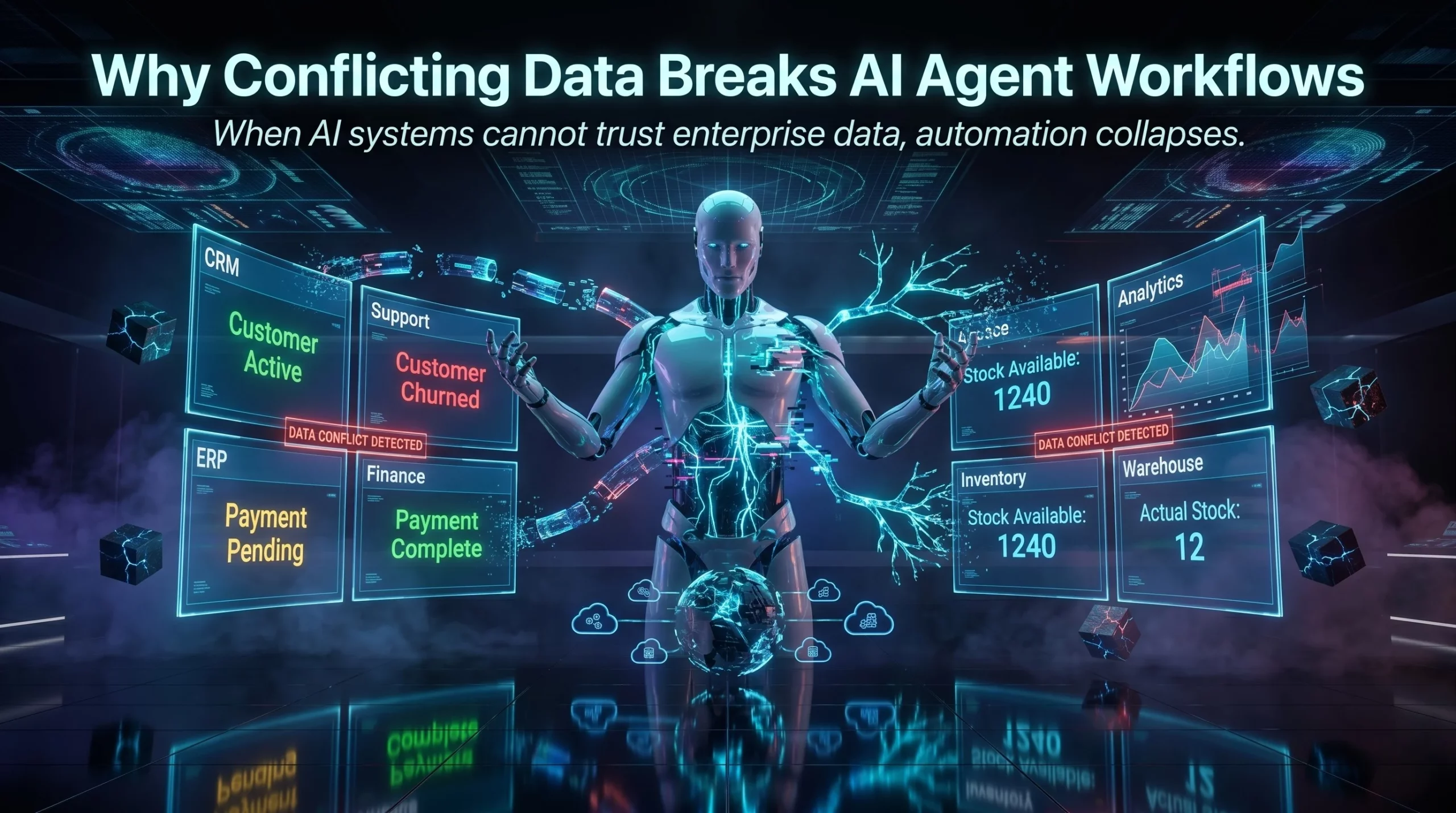
AI agents are designed to move fast. They check data, make decisions, trigger workflows, and update systems without waiting for manual input. But that speed becomes dangerous when the data behind the agent is inconsistent.
If one system shows the wrong delivery date, another shows a different stock level, and a third shows a conflicting customer record, the AI agent has no reliable version of truth to follow. It may choose the wrong data, stop the workflow, or produce an output that looks confident but is completely incorrect. That is why conflicting data does not just slow AI agents down — it breaks the trust needed to use them at scale.
In simple terms, multiple versions of truth happen when different teams, tools, or systems hold different records of the same information — and none of them agree.
Sales updates the CRM. Ops updates a spreadsheet. Finance pulls from an ERP system. Customer support has their own ticketing database. Each team trusts their own source, and nobody is wrong within their own silo. But when an AI agent tries to pull data to make a decision, it doesn’t know which version to trust. So it either makes assumptions, picks one arbitrarily, or — if it’s well-designed — flags a conflict and stalls.
The problem isn’t new. Organisations have lived with this for years and managed it through human workarounds: someone always “knows” which spreadsheet is the real one, or there’s an unwritten rule that the CRM takes priority on Mondays. Humans adapt. AI agents don’t.
This is closely related to the broader scattered knowledge problem in AI agent readiness — where information is spread across tools and teams in ways that make it structurally inaccessible to an autonomous system.
Here’s the catch: human intelligence is remarkably good at resolving ambiguity through context, relationships, and institutional memory. When a senior analyst sees two conflicting inventory numbers, they know to call the warehouse manager, not trust the spreadsheet.
AI agents don’t have that social layer. They operate on what they’re given. If the data they receive is inconsistent, their outputs will be inconsistent — at best. At worst, they’ll confidently act on the wrong data without flagging an error at all.
Think about what that means when you deploy an AI agent to handle:
The stakes scale with the automation. That’s why, as we explored in our piece on why AI agents fail without real-time data access, data quality and data currency are the twin pillars your AI deployment sits on. Remove either one, and the whole structure wobbles.
Most data conflicts don’t appear overnight. They accumulate over years of tool sprawl, team growth, and process workarounds. Here’s how it usually happens:
Shadow spreadsheets become the real source of truth. A team builds a spreadsheet to solve a gap in the official system. It works so well that everyone starts using it. Six months later, it’s the most trusted data source in the department — but nobody in the platform team knows it exists.
Tools are integrated badly or not at all. Two platforms share data but there’s no validation layer. Small discrepancies — a typo here, a missing field there — compound over time until the records are meaningfully different.
Naming conventions diverge across teams. “Client” in one system is “Account” in another. “Closed Won” in sales is “Active” in finance. The human brain maps these automatically. An AI agent treats them as separate concepts.
Legacy migrations leave orphan records. You moved from Platform A to Platform B, but some historical data stayed behind. Both systems are now referenced in different workflows, and nobody has audited which records only exist in the old system.
Processes that live only in people’s heads create invisible data paths. This is the connection to undocumented workflows in AI automation — when the steps that generate or modify data aren’t written down, the data itself becomes unreliable and untraceable.
You don’t need a data audit to get a rough diagnostic. Answer these five questions honestly:
Many of the organisations we work with discover this problem for the first time when they start an AI project. The AI readiness conversation forces them to examine their data architecture in ways that routine operations never did. And as we discussed in our LinkedIn Pulse on undocumented workflows blocking AI automation, the gap between what’s documented and what’s real is almost always wider than leaders expect.
A single source of truth doesn’t mean all your data lives in one tool. That’s a misconception worth clearing up.
It means that for any given piece of information, there is a clearly defined, authoritative source — and every other system that uses that information pulls from it or defers to it. Other systems can display or reference the data, but they don’t own it.
In a well-architected organisation:
This architecture feels obvious when you write it out. But building it requires deliberate decisions that most organisations have never explicitly made. Someone has to own the process of designating which system is the master for each data type, and then someone has to enforce it.
That’s where data governance comes in — and AI agents are a very compelling reason to finally take it seriously.

The good news is that this is fixable. The not-so-good news is that it takes time, intention, and cross-functional ownership. Here’s where to start:
Step 1: Run a data source inventory. For every major business process, map the data it uses. Document where that data lives, who creates it, and who updates it. You’ll find duplication immediately.
Step 2: Designate system ownership. For every data type, name the single authoritative system. This is a business decision as much as a technical one — it requires alignment between department heads, not just IT.
Step 3: Eliminate or subordinate shadow sources. If a spreadsheet is being used as a de facto system of record, either migrate that data into the authoritative platform or create a formal sync that makes the spreadsheet read-only. Either way, you remove the risk of divergence.
Step 4: Create data validation rules at ingestion. Every new record entering the system should pass basic validation — field formats, required fields, acceptable value ranges. This prevents low-quality data from entering the authoritative source.
Step 5: Build a change log. Every update to a critical data field should be timestamped and attributed. This is non-negotiable for AI agent environments — if an agent acts on bad data, you need to be able to trace it back.
Step 6: Test with your AI use case first. Before full deployment, run your intended AI workflow against the data as it exists today. Look for the points where the agent hesitates, returns an error, or — most dangerously — confidently produces the wrong output. These are your data gaps.
We’ve written more about why conflicting data and multiple versions of truth is specifically damaging to AI agent performance in our LinkedIn Pulse on this exact topic — worth a read if you’re mid-project and hitting unexpected friction.
Let’s be honest about the business risk here.
An AI agent operating on conflicting data doesn’t fail loudly. It fails quietly, consistently, and at scale. Every interaction it handles using the wrong data is a small compounding error. A wrong quote here. An incorrect update there. A report that looks fine but doesn’t reflect reality.
In a human-operated process, these errors get caught — in meetings, email threads, escalations. In an AI-operated process, they multiply before anyone notices. By the time the problem surfaces, the damage is already distributed across hundreds or thousands of touchpoints.
And here’s the thing about trust: once a team loses confidence in an AI agent’s outputs, you don’t get it back easily. They’ll default to manual verification, which defeats the purpose of automation. The ROI disappears. The project gets blamed. The technology gets blamed. When the real culprit was always the data.
AI agents are powerful. They genuinely can transform how your organisation operates — reducing cycle times, eliminating repetitive tasks, improving decision speed. But they are multipliers, not fixers. They multiply whatever you put in front of them: good data or bad, clean processes or chaotic ones.
Multiple versions of truth is a structural problem that AI agents will surface — loudly — within weeks of deployment. The organisations that get this right don’t do it after the pilot fails. They do it before the project starts.
If you’re planning an AI agent deployment, start your readiness assessment with the data layer. Map your sources. Find the conflicts. Fix the ownership. Then build.
The technology is ready. The real question is whether your data foundation is.
How can you supercharge your business with bespoke solutions and products.