You gave your AI agent access to everything. Every document. Every Slack message. Every PDF your company ever produced. You scaled the context window from 32k tokens to 128k, then to a million.
And somehow, it got worse.
Your agent starts strong on a task, then by step three, it’s summarizing the marketing team’s holiday schedule instead of the Q3 sales data you asked for. It hallucinates facts. It drifts off course. It burns through your token budget processing irrelevant footnotes and disclaimers that add zero value to the output.
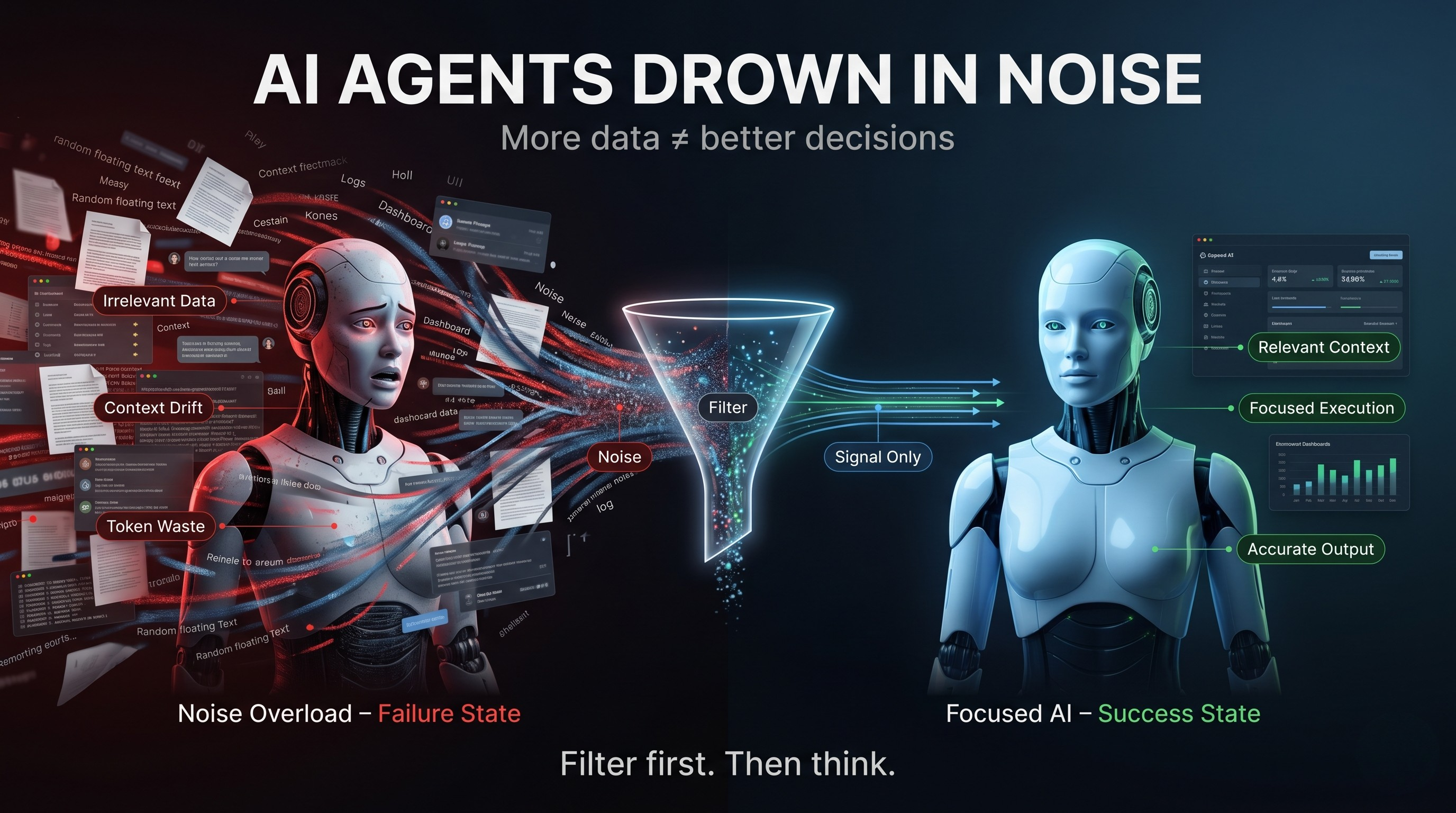
Here’s what most people miss: the problem isn’t that your AI doesn’t have enough context. The problem is it doesn’t know what to ignore.
We’ve built incredible digital brains, but we forgot to give them a brainstem. We’re facing a massive signal-to-noise problem, and the industry’s solution—making context windows bigger—is like turning up the volume when you can’t hear over the crowd. It doesn’t help. It makes things worse.
Let’s talk about why your AI agents are drowning in noise, what your brain does that they don’t, and how to build the filtering system that separates high-value signals from expensive junk.
The prevailing assumption in most boardrooms is simple: more access equals better intelligence. If we just give the AI “all the context,” it’ll naturally figure out the right answer.
It doesn’t.
Here’s the uncomfortable truth: research shows that hallucinations cannot be fully eliminated under current LLM architectures. Even with enormous context windows, the average hallucination rate for general knowledge sits around 9.2%. In specialized domains? Much worse.
The issue isn’t capacity—it’s attention. When an agent “sees” everything, it suffers from the same cognitive overload a human would face if you couldn’t filter out background noise. As context windows expand, models can start to overweight the transcript and underuse what they learned during training.
DeepMind’s Gemini 2.5 Pro supports over a million tokens, but begins to drift around 100,000 tokens. The agent doesn’t synthesize new strategies—it just repeats past actions from its bloated context history. For smaller models like Llama 3.1-405B, correctness begins to fall around 32,000 tokens.
Think about that. Models fail long before their context windows are full. The bottleneck isn’t size—it’s signal clarity.
Every time your agent processes a chunk of irrelevant text, you’re paying for it. You are burning budget processing “sensory junk”—irrelevant paragraphs, disclaimers, footers, and data points—that add zero value to the final output.
We’re effectively paying our digital employees to read junk mail before they do their actual work.
When you ask an agent to analyze three months of sales data and draft a summary, it shouldn’t be wading through every tangential Confluence page about office snacks or outdated onboarding docs. But without a filter, the noise is just as loud as the signal.
This is the silent killer of AI ROI. Not the flashy failures—the quiet, invisible drain of processing costs and degraded accuracy that compounds over thousands of queries.
Your brain processes roughly 11 million bits of sensory information per second. You’re aware of about 40.
How? The Reticular Activating System (RAS)—a pencil-width network of neurons in your brainstem that acts as a gatekeeper between your subconscious and conscious mind.
The RAS is a net-like formation of nerve cells lying deep within the brainstem. It activates the entire cerebral cortex with energy, waking it up and preparing it for interpreting incoming information.
It’s not involved in interpreting what you sense—just whether you should pay attention to it.
Right now, you’re not consciously aware of the feeling of your socks on your feet. You weren’t thinking about the hum of your HVAC system until I mentioned it. Your RAS filtered those inputs out because they’re not relevant to your current goal (reading this article).
But if someone says your name across a crowded room? Your RAS snaps you to attention instantly. It’s constantly scanning for what matters and discarding what doesn’t.
Here’s the thing: without the RAS, your brain would be paralyzed by sensory overload. You wouldn’t be able to function. You would be awake, but effectively comatose, drowning in a sea of irrelevant data.
That’s exactly what’s happening to AI agents right now.
We’re obsessed with giving them total awareness—massive context windows, sprawling RAG databases, access to every system and document. But we’re not giving them selective ignorance. We’re not teaching them what to filter out.
When agents can’t distinguish signal from noise, they become what we call “confident liars in your tech stack”—producing outputs that sound authoritative but are fundamentally wrong.
Let’s get specific. Here’s exactly how information overload destroys your AI agents’ effectiveness—and your budget.
When an agent is drowning in data, it tries to find patterns where none exist. It connects dots that shouldn’t be connected because it cannot distinguish between a high-value signal (the Q3 financial report) and low-value noise (a draft email from 2021 speculating on Q3).
The agent doesn’t hallucinate because it’s creative. It hallucinates because it’s confused.
Poor retrieval quality is the #1 cause of hallucinations in RAG systems. When your vector search pulls semantically similar but irrelevant documents, the agent fills gaps with plausible-sounding nonsense. And because language models generate statistically likely text, not verified truth, it sounds perfectly reasonable—even when it’s completely wrong.
You give your agent a multi-step goal: “Analyze last quarter’s customer support tickets and identify the top three product issues.”
Step one: pulls support tickets. Good.
Step two: starts analyzing. Still good.
Step three: suddenly summarizes your customer success team’s vacation policy.
What happened? The retrieved documents contained irrelevant details, and the agent, lacking a filter, drifted away from the primary goal. It lost the thread because the noise was just as loud as the signal.
Without goal-aware filtering, agents treat every piece of information as equally important. A compliance footnote gets the same attention weight as the core data you actually need. The result? Context drift hallucinations that derail entire workflows—agents that need constant human supervision to stay on track.
Let’s do the math. Every irrelevant paragraph your agent processes costs tokens. If you’re running Claude Sonnet at $3 per million input tokens and your agent processes 500k tokens per complex task—but 300k of those tokens are junk—you’re paying $0.90 per task for literally nothing.
Scale that to 10,000 tasks per month. You’re burning $9,000 monthly on noise.
Larger context windows don’t solve the attention dilution problem. They can make it worse. More tokens in = higher costs + slower response times + more opportunities for the model to latch onto irrelevant information.
This is why understanding AI efficiency and cost control is critical before scaling your deployment.
So how do we fix this? How do we give AI agents the equivalent of a biological RAS—a system that filters before processing, focuses on goals, and escalates when uncertain?
Here are the three pillars.
Your biological RAS filters sensory input before it reaches your conscious mind. In AI architecture, we replicate this with semantic routers.
Instead of giving a worker agent access to every tool and every document index simultaneously, the semantic router analyzes the task first and routes it to the appropriate specialized subsystem.
Example: If the task is “Find compliance risks in this contract,” the router sends it to the legal knowledge base and compliance toolset—not the entire company wiki, not the HR policies, not the engineering docs.
Monitor and optimize your RAG pipeline’s context relevance scores. Poor retrieval is the #1 cause of hallucinations. Semantic routing ensures you’re retrieving from the right sources before you even hit the vector database.
This is selective awareness at the system level. Only relevant knowledge domains get activated.
Here’s where it gets interesting. Even with the right knowledge domain activated, you need to bias the agent’s attention toward the current goal.
In a Digital RAS architecture, a supervisory agent sets what researchers call “attentional bias.” If the goal is “Find compliance risks,” the supervisor biases retrieval and processing toward keywords like “risk,” “liability,” “regulatory,” and “compliance.”
When the worker agent pulls results from the vector database, the supervisor ensures it filters the RAG results based on the current goal. It forces the agent to discard high-ranking but contextually irrelevant chunks and focus only on what matters.
This transforms the agent from a passive reader into an active hunter of information. It’s no longer processing everything—it’s processing what it needs to complete the goal.
Your biological RAS knows when to wake you up. When it encounters something it can’t handle on autopilot—a strange noise at night, an unexpected pattern—it escalates to your conscious mind.
AI agents need the same mechanism.
In a well-designed system, agents track their own confidence scores. When uncertainty crosses a threshold—ambiguous input, conflicting data, edge cases outside training distribution—the agent escalates to human review instead of guessing.
When you don’t have enough information to answer accurately, say “I don’t have that specific information.” Never make up or guess at facts. This simple principle, hardcoded as a confidence threshold, prevents the majority of hallucination-driven failures.
The agent knows what it knows. More importantly, it knows what it doesn’t know—and asks for help.
This isn’t theoretical. Organizations implementing Digital RAS principles are seeing measurable improvements across the board.
Research shows knowledge-graph-based retrieval reduces hallucination rates by 40%. When you combine semantic routing with goal-aware filtering and structured knowledge graphs, you’re giving agents a map, not a pile of documents.
RAG-based context retrieval reduces hallucinations by 40–90% by anchoring responses in verified organizational data rather than relying on general training knowledge. The key word is verified. Filtered, relevant, goal-aligned data—not everything in the database.
When your agent processes only what it needs, token consumption drops dramatically. In production deployments, teams report 50-70% reductions in input token costs after implementing semantic routing and attention bias.
You’re not paying to read junk mail anymore. You’re paying for signal.
Smaller, focused context windows process faster. A model with a focused 10K token input may produce fewer hallucinations than a model with a 1M token window suffering from severe context rot, because there’s less noise competing for attention.
Speed and accuracy aren’t trade-offs when you filter smart. They move together.
You don’t need to rebuild your entire AI infrastructure overnight. Here’s where to start.
Identify the 3-5 distinct knowledge domains your agents need to access. Legal, product, customer support, engineering, finance—whatever makes sense for your use case.
Build routing logic that analyzes the user query or task description and activates only the relevant domain. You can do this with simple keyword matching to start, then upgrade to learned routing as you scale.
The goal: stop giving agents access to everything. Start giving them access to the right thing.
Implement a lightweight supervisor layer that tracks the agent’s current goal and biases retrieval accordingly. This can be as simple as dynamically adjusting vector search filters based on extracted goal keywords.
For more complex workflows, use a supervisor agent that maintains goal state across multi-step tasks and intervenes when the worker agent drifts. Learn more about implementing intelligent AI agent architectures that maintain focus across complex workflows.
You can’t optimize what you don’t measure. Start tracking:
Context engineering is the practice of curating exactly the right information for an AI agent’s context window at each step of a task. It has replaced prompt engineering as the key discipline.
If your context relevance score is below 70%, you have a noise problem. Fix the filter before you scale the window.
The race to bigger context windows was always a distraction. The real question was never “How much can my AI see?”
The real question is: “What should my AI ignore?”
Your brain processes millions of inputs per second and stays focused because it has a biological filter—the RAS—that knows what matters and discards the rest. Your AI agents need the same thing.
Stop dumping everything into the context and hoping for the best. Stop paying to process junk. Start building systems that filter before they retrieve, focus on goals, and escalate when uncertain.
Because here’s the thing: the companies winning with AI right now aren’t the ones with the biggest models or the longest context windows. They’re the ones who figured out how to cut through the noise.
If you’re ready to stop wasting budget on irrelevant data and start building agents that actually stay on task, it’s time to rethink your architecture. Not bigger brains. Smarter filters.
That’s the difference between AI that impresses in demos and AI that delivers real ROI in production.
How can you supercharge your business with bespoke solutions and products.