
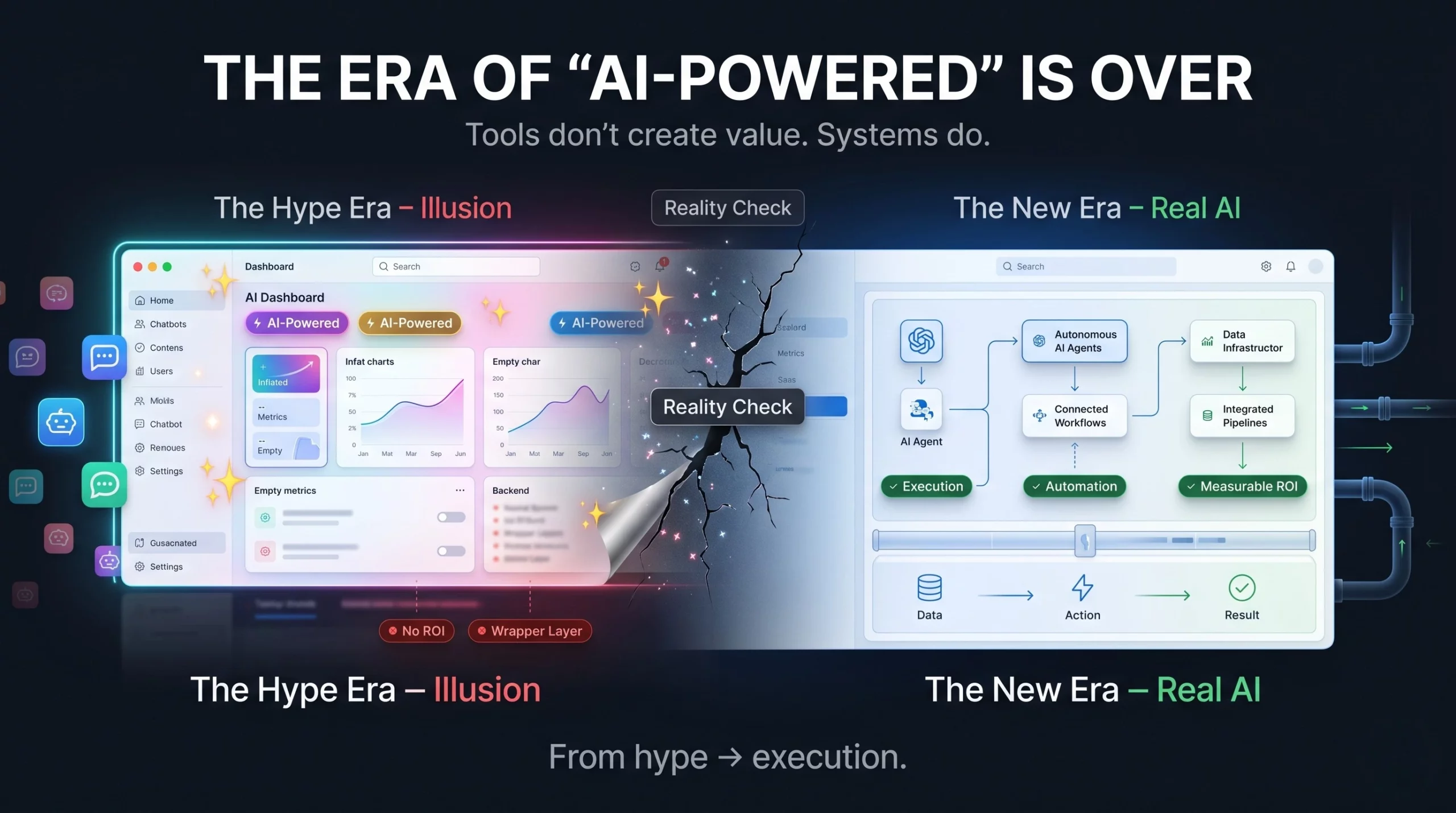
If your primary software vendor recently added a shiny, sparkle-icon button to their user interface, called it “AI-powered,” and subsequently increased your licensing fee by 20%, you are not alone. And you are not innovating. You are being taxed.
We have officially reached the peak of inflated expectations on the Gartner hype cycle, and the trough of disillusionment is right around the corner. Over the past two years, companies rushed to buy generative tools. The mandate from the board was simple: Do AI. So, management bought ChatGPT licenses, bolted a chatbot onto the customer service portal, and waited for the massive efficiency gains that the headlines promised.
Now, the CFO is asking for the receipts. And for most companies, those receipts are looking incredibly thin.
The era of the “AI-powered” wrapper is dead. What most people miss is that buying a tool is not the same as redesigning a business. If you are a CEO, CTO, or business leader in 2026, the question is no longer about which language model is the smartest. The real question is how you transition from buying shiny AI features to building fundamentally AI-native operating models. Let’s break down exactly what that looks like, and why the winners of the next decade are shifting their focus from experimentation to disciplined execution.
Let’s be honest. Tacking the word “AI” onto a mediocre product doesn’t make it a good product. It just makes it an expensive one.
Between 2023 and 2025, the market was flooded with “wrappers.” These were essentially legacy software platforms that bolted an API connection to a large language model (LLM) onto their existing, clunky workflows. They didn’t change how the software worked; they just added a chat interface on top of it.
Here is the catch with the wrapper strategy: if your underlying business process is broken, adding AI just helps you execute a broken process much faster.
Imagine a procurement department that requires seven different manual approvals, a labyrinth of email threads, and cross-referencing three outdated spreadsheets just to onboard a new vendor. An “AI-powered” wrapper might help an employee draft the vendor approval emails in five seconds instead of five minutes. Sounds great, right?
It’s not. The core friction—the seven approvals and the disconnected data silos—still exists. The AI didn’t solve the business problem; it just applied a temporary bandage to a symptom. This fundamental misunderstanding of workflow vs. technology is exactly why AI transformations fail before they ever reach scale. Companies try to force-fit a revolutionary technology into an evolutionary, outdated operational model.
Top management must stop buying technology that merely assists human bottlenecks. The goal isn’t to help your employees tolerate bad internal systems. The goal is to eliminate those systems entirely.
The first wave of AI adoption was defined by the “copilot.” A copilot is exactly what it sounds like: a digital assistant that sits next to a human operator, offering suggestions, auto-completing code, or summarizing meeting notes. Copilots are helpful, but they have a fatal flaw. They require constant, undivided human supervision.
We are now transitioning out of the copilot era and into the agentic era. According to recent insights from Bain & Company, the timeline for transitioning from generative AI to autonomous agentic AI is accelerating faster than anticipated.
An AI agent doesn’t just draft an email; it receives an objective, plans a sequence of actions, logs into your CRM, updates the client record, drafts the communication, sends it, and logs the response—all without a human clicking “approve” at every single step.
But moving to autonomous agents requires adult supervision at the architectural level. You cannot let agents loose in your tech stack based on vague prompts and good vibes. You have to shift to rigid, spec-driven development. When an AI moves from advising a human to executing actions on behalf of the company, the engineering standards must elevate. CTOs must build deterministic rails around probabilistic models. If you don’t, you aren’t building a digital workforce; you are building a liability.
If there is one person in the C-suite who is immune to the AI hype, it is the Chief Financial Officer. The CFO does not care if an AI model can write a sonnet in the style of Shakespeare. The CFO cares about margin expansion, cost-to-serve, and revenue growth.
Right now, enterprise leaders are drowning in what MIT Sloan calls “soft ROI.” Soft ROI is the illusion of productivity.
Software vendors love to sell soft ROI. Their pitch sounds like this: “Our AI-powered tool will save every employee on your team three hours a week!”
The management team hears this, multiplies three hours by 500 employees, multiplies that by the average hourly wage, and calculates a massive, multi-million dollar return on investment. They sign the contract. A year later, they look at the balance sheet. Revenue hasn’t gone up. Headcount costs haven’t gone down. The multi-million dollar ROI is nowhere to be found.
What most people miss is the efficiency paradox. If you save an employee three hours a week, and you do not systematically redirect those three hours into a tracked, revenue-generating activity, you haven’t saved the company a single dollar. You have simply subsidized your employee’s free time. They are going to spend those three hours scrolling LinkedIn or taking a longer lunch.
In the post-hype reality, top management must demand hard ROI. You measure this by tracking concrete metrics:
Reduction in cost-per-transaction
Deflection rate of Tier-1 support tickets
Accelerated time-to-market for new code deployments
Direct increase in outbound sales conversion rates
If your AI implementation strategy does not tie directly to one of these hard metrics, it is a research project, not a business strategy.
While the CEO and CFO are arguing over business metrics, the CTO is left holding a fragmented, chaotic tech stack. During the hype cycle, engineering teams were pressured to stand up AI features quickly to appease the board. This led to a massive accumulation of technical debt.
The mandate for technology leaders today is to stop building shiny front-end chat interfaces and start fixing the backend data architecture.
Harvard Business Review notes that the primary bottleneck for enterprise AI deployment is no longer the intelligence of the model, but the quality of the proprietary data feeding it. If your internal data is unstructured, siloed, and full of conflicting information, your AI agent will be confident, articulate, and completely wrong.
Furthermore, as you deploy agents to execute workflows, CTOs must guard against instruction misalignment. This occurs when an AI system technically follows the prompt it was given but completely violates the intent of the business rule because it lacks structural context.
To rebuild the stack for the post-hype era, CTOs need to focus on three critical pillars:
Unified Data Lakes: AI cannot reason across systems if your marketing data lives in HubSpot, your financial data in Oracle, and your product data in Jira, with no connective tissue between them.
Retrieval-Augmented Generation (RAG) Integrity: Ensuring the system pulls the correct, most recent internal documentation before it generates an answer or takes an action.
Auditability: When an agentic system makes a mistake—and it will—your engineers must be able to trace the exact logical path the model took to reach that conclusion. Black-box decision-making is unacceptable in an enterprise environment.
You cannot delegate a fundamental business transformation to a mid-level IT manager.
According to McKinsey, organizations where the CEO actively champions and tracks the AI strategy achieve a 20% higher return on their digital investments compared to companies where the strategy is outsourced to siloed departments.
The era of “AI-powered” tools allowed management to be passive. You bought a software license, handed it to the marketing team, and crossed your fingers. The era of AI-native operating models requires top management to be aggressively active.
You have to rethink headcount. If AI agents are now capable of handling 40% of your routine data processing and initial customer triage, you do not necessarily need to fire 40% of your staff. But you absolutely must redesign their roles. Your human workforce needs to transition from “doers” of repetitive tasks to “managers” of digital agents.
This requires a massive upskilling initiative focused on systems thinking. Your team needs to know how to validate AI outputs, how to structure complex workflows, and how to intervene when an autonomous agent encounters an edge case it cannot solve.
The real win here is not replacing human intelligence; it is elevating it. When you strip away the administrative burden of the modern workday, you free your best talent to focus on high-judgment, high-empathy, and high-strategy work—the things machines still cannot do.
The hype cycle was loud, chaotic, and largely unproductive. But the post-hype reality is where the actual fortunes will be made.
The winners of the next decade won’t be the companies that brag about how many AI tools they bought. They will be the companies that quietly and methodically redesigned their core business processes around autonomous workflows, demanded hard financial returns, and treated AI not as a feature, but as a foundation.
Stop buying into the “AI-powered” marketing noise. Realign your executive team, clean up your data architecture, and focus entirely on execution. The technology is finally ready. The real question is: are you?
How can you supercharge your business with bespoke solutions and products.