
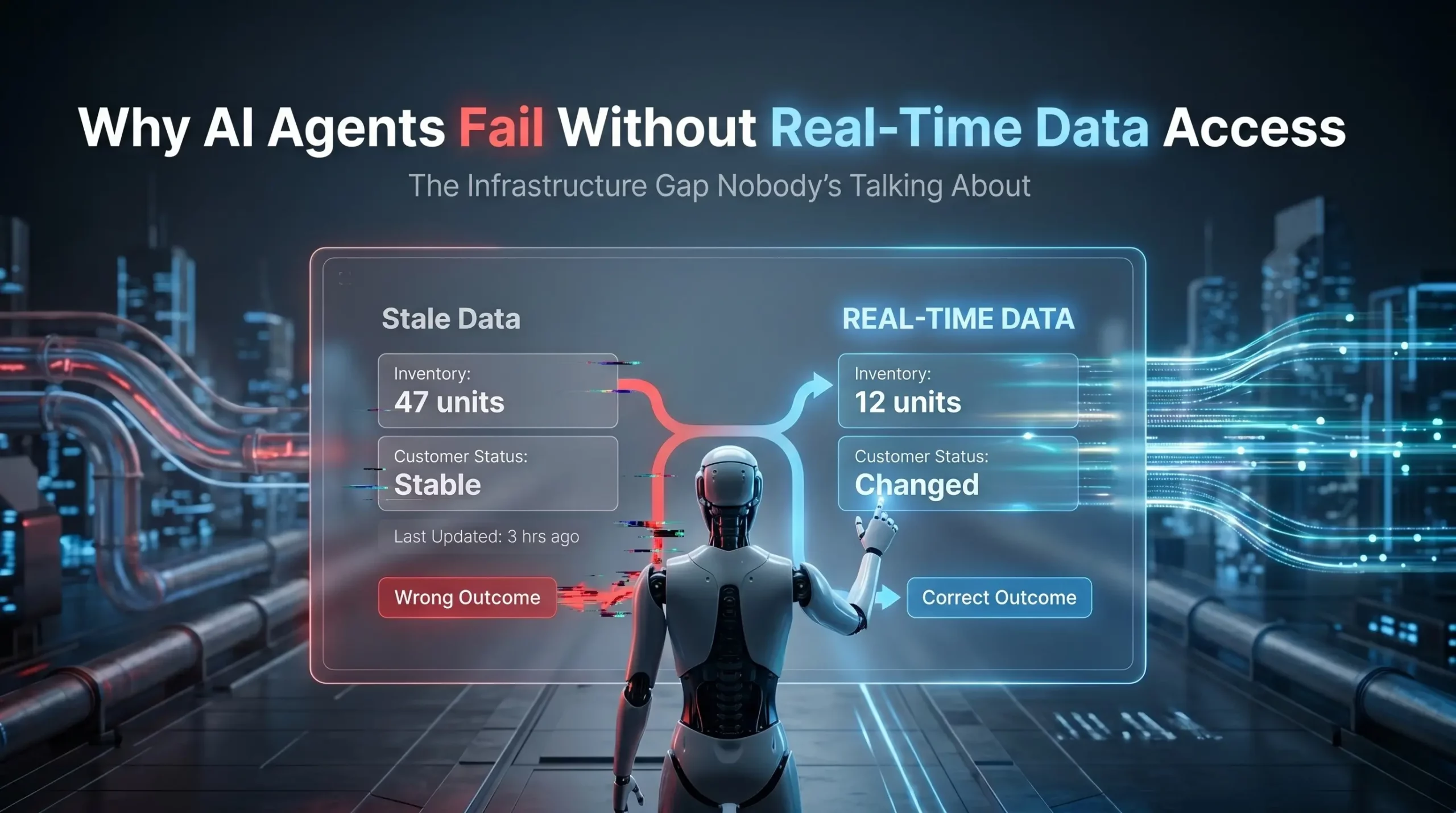
You’ve deployed AI agents. The demos looked impressive. The pilot went smoothly. Then you pushed to production and everything started breaking in ways you didn’t expect.
Sound familiar?
Here’s what most organizations discover too late: the difference between AI agents that work and AI agents that fail catastrophically isn’t about the model, the training data, or even the architecture. It’s about something far more fundamental—whether your agents can access current information when they need to make decisions.
Real-time data access for AI agents isn’t a luxury feature you add later. It’s the foundational infrastructure that determines whether autonomous systems can function reliably at all.
Most companies building AI agents today are essentially constructing sophisticated decision-making engines and then feeding them information that’s already outdated. They’re surprised when those agents make terrible decisions—but the failure was built in from the start.
Let’s talk about why this happens, what real-time data access actually means in practice, and what you need to build if you want AI agents that don’t just work in demos but actually deliver value in production.
Real-time data access means your AI agents can query and retrieve current information with minimal latency—typically milliseconds to seconds—rather than working from periodic batch updates that might be hours or days old.
This isn’t about making batch processing faster. It’s a fundamentally different approach to how data moves through your systems.
Traditional batch processing says: collect data throughout the day, process it in chunks during off-peak hours, and make updated datasets available periodically. Your morning report contains yesterday’s data. Your agent making a decision at 2 PM is working with information from last night’s batch job.
Streaming architectures say: treat every data change as an immediate event, process it the moment it occurs, and make it queryable within milliseconds. Your agent making a decision at 2 PM sees what’s happening at 2 PM.
For AI agents making autonomous decisions, that difference isn’t just about speed. It’s about whether the decision is based on reality or on a snapshot that no longer reflects the current state of your business.
According to research from CIO Magazine, modern fraud detection systems now correlate transactions with real-time device fingerprints and geolocation patterns to block fraud in milliseconds. The system can’t wait for the nightly batch update. By then, the fraudulent transaction has already settled and the money is gone.
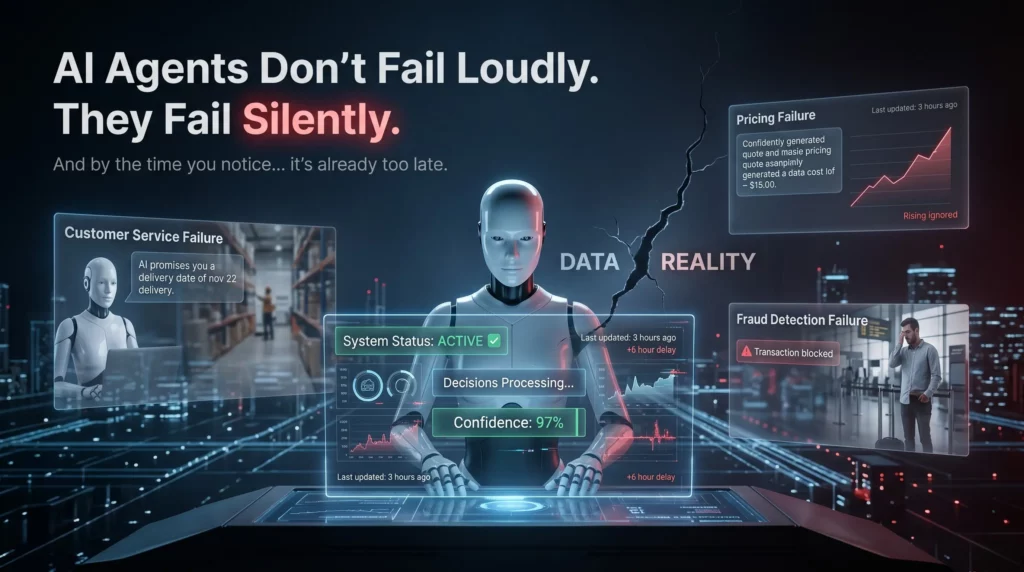
Here’s what makes stale data particularly dangerous for AI agents: the failure mode is silent.
When a traditional application encounters bad data, it often throws an error or crashes in obvious ways. You know something’s wrong because the system stops working.
AI agents don’t fail like that. They keep running. They keep making decisions. Those decisions just get progressively worse as the gap between their information and reality widens.
Research from Shelf found that outdated information leads to temporal drift, where AI agents generate responses based on obsolete knowledge. This is particularly critical for Retrieval-Augmented Generation (RAG) systems, where stale data produces incorrect recommendations that look authoritative because they’re well-formatted and delivered with confidence.
Think about what this means in a real business context:
Your customer service agent promises a shipping timeline based on inventory data from this morning. But there was a warehouse issue three hours ago that your logistics team resolved by redirecting shipments. The agent doesn’t know. It commits to dates you can’t meet. When documentation doesn’t reflect actual processes, agents make promises the business can’t keep.
Your pricing agent calculates a quote using rate tables that were updated yesterday, but your largest supplier announced a price increase this morning. Your quote is now below cost. You won’t know until the order processes and someone manually reviews the margin.
Your fraud detection system flags a legitimate high-value transaction from your best customer. Why? Because it’s comparing against behavior patterns that are six hours old. In those six hours, the customer landed in a different country for a business trip. The agent sees the transaction location, doesn’t see the updated travel status, and blocks the purchase.
None of these scenarios involve model failure. The AI is working exactly as designed. The infrastructure is the problem.
According to comprehensive analysis of agentic AI statistics, 88% of AI agents fail to reach production deployment. The 12% that succeed deliver an average ROI of 171% (192% in the US market).
What separates the winners from the failures?
Most organizations assume it’s about the sophistication of the model or the quality of the training data. Those factors matter, but they’re not the primary differentiator.
The real gap is infrastructure.
Deloitte’s 2025 Emerging Technology Trends study found that while 30% of organizations are exploring agentic AI and 38% are piloting solutions, only 14% have systems ready for deployment. The primary bottleneck cited? Data architecture.
Nearly half of organizations (48%) report that data searchability and reusability are their top barriers to AI automation. That’s code for: “our data infrastructure can’t support what these agents need to do.”
Organizations with scattered knowledge across multiple systems face compounded challenges—when agents can’t find authoritative, current information, they either make decisions with incomplete data or become paralyzed by conflicting sources.
Here’s the pattern that plays out repeatedly:
Pilot phase: Controlled environment, limited data sources, manageable complexity. The agent works because you’ve carefully curated its information access.
Production deployment: Real-world complexity, dozens of data sources, conflicting information, latency issues, and stale data scattered across systems. The agent that worked perfectly in the pilot now makes unreliable decisions because the infrastructure can’t deliver current, consistent information at scale.
The companies that close this gap are the ones investing in boring infrastructure: Change Data Capture (CDC) pipelines, streaming platforms, semantic layers, and data freshness monitoring. Not sexy. Absolutely critical.
If you’re serious about deploying AI agents that work in production, here’s what the infrastructure stack actually looks like:
Source Systems with CDC Pipelines
Your databases, CRMs, ERPs, and operational systems need Change Data Capture enabled. Every insert, update, and delete gets captured as an event the moment it happens. Tools like Debezium, Streamkap, or AWS DMS handle this layer.
Streaming Platform
Those events flow into a streaming platform—Apache Kafka, Apache Pulsar, AWS Kinesis, or Google Cloud Pub/Sub. This is your real-time data backbone. Events are processed immediately and made available to consumers within milliseconds.
According to the 2026 Data Streaming Landscape analysis, 90% of IT leaders are increasing their investments in data streaming infrastructure specifically to support AI agents. Market research suggests 80% of AI applications will use streaming data by 2026.
Semantic Layer
Raw data isn’t enough. AI agents need context. A semantic layer sits on top of your streaming data to provide business definitions, relationship mappings, and data quality rules. This layer answers questions like “what does ‘active customer’ actually mean?” and “which revenue figure is the source of truth?”
Data Freshness Monitoring
You need systems that continuously track when data was last updated and alert you when freshness degrades. This isn’t traditional uptime monitoring—it’s monitoring whether the data your agents are accessing is still current enough to support reliable decisions.
Agent Query Layer
Finally, your AI agents need an optimized query interface that lets them access both current state and historical context with minimal latency. This might be a high-performance database like Aerospike, a data lakehouse like Databricks, or a specialized vector database for RAG applications.
Research from Aerospike emphasizes that organizations must invest in a data backbone delivering both ultra-low latency and massive scalability. AI agents thrive on fast, fresh data streams—the need for accurate, comprehensive, real-time data that scales cannot be overstated.
Let’s be direct: you can’t retrofit real-time data access onto batch-based architectures and expect it to work reliably.
The companies trying this approach encounter predictable failure patterns:
Race Conditions: Agent A makes a decision based on data snapshot 1. Agent B makes a conflicting decision based on snapshot 2. Neither knows about the other’s action because the data layer doesn’t synchronize in real time.
Context Staleness: According to analysis of AI context failures, agents frequently have access to both current and outdated information but default to the stale version because it ranked higher in similarity search or was cached more aggressively.
Orchestration Drift: Research from InfoWorld found that agent-related production incidents dropped 71% after deploying event-based coordination infrastructure. Most eliminated incidents were race conditions and stale context bugs that are structurally impossible with proper real-time architecture.
Silent Degradation: The system doesn’t fail obviously. It just makes worse decisions over time as data freshness degrades. By the time you notice the problem, you’ve already made hundreds or thousands of bad decisions.
Here’s a real example from production failure analysis: a sales agent connected to Confluence and Salesforce worked perfectly in demos. In production, it offered a major customer a 50% discount nobody authorized. The root cause? An outdated pricing document in Confluence still referenced a promotional rate from two quarters ago. The agent treated it as current because nothing in the infrastructure flagged it as stale.
The documentation-reality gap isn’t just an accuracy problem—it’s a trust-destruction mechanism that makes AI agents unreliable at scale.
Real-time data infrastructure isn’t cheap. Streaming platforms, CDC pipelines, semantic layers, and monitoring systems require investment in technology, engineering time, and operational overhead.
So when does it actually make economic sense?
Cloud-native data pipeline deployments are delivering 3.7× ROI on average according to Alation’s 2026 analysis, with the clearest gains in fraud detection, predictive maintenance, and real-time customer personalization.
The ROI calculation comes down to three factors:
Decision Velocity: How quickly do conditions change in your business? If you’re in e-commerce, financial services, logistics, or healthcare, conditions change by the minute. Batch processing means your agents are always operating with outdated information. The cost of wrong decisions based on stale data exceeds the infrastructure investment.
Decision Consequence: What’s the cost of a single wrong decision? In fraud detection, one missed fraudulent transaction can cost thousands of dollars. In healthcare, one outdated patient data point can have life-threatening consequences. High-consequence decisions justify real-time infrastructure.
Scale of Automation: How many autonomous decisions are your agents making per day? If it’s dozens, batch processing might be adequate. If it’s thousands or millions, the aggregate cost of decision errors from stale data quickly outweighs infrastructure costs.
According to comprehensive statistics on agentic AI adoption, the global AI agents market is projected to grow from $7.63 billion in 2025 to $182.97 billion by 2033—a 49.6% compound annual growth rate. That explosive growth is happening because organizations are discovering that agents with proper data infrastructure actually deliver value.
If you’re starting from batch-based infrastructure and need to support AI agents with real-time data access, here’s a practical migration path:
Phase 1: Identify Critical Data Sources
Not all data needs real-time access. Start by identifying which data sources your AI agents actually query for autonomous decisions. Customer data? Inventory? Pricing? Transaction history? Map the data flows and prioritize based on decision frequency and consequence.
Phase 2: Implement CDC on High-Priority Sources
Enable Change Data Capture on your most critical databases. This captures every change as it happens and streams it to your data platform. Start with one or two sources, validate that the pipeline works reliably, then expand.
Phase 3: Deploy Streaming Infrastructure
Stand up your streaming platform—whether that’s Kafka, Pulsar, Kinesis, or another solution depends on your cloud strategy and technical requirements. Configure it for high availability and monitoring from day one.
Phase 4: Build the Semantic Layer
This is where many organizations stumble. Raw event streams aren’t enough—you need business context. Invest in data catalog tools, governance frameworks, and automated metadata management. Organizations struggling with scattered knowledge across systems need this layer to provide agents with authoritative, consistent definitions.
Phase 5: Implement Freshness Monitoring
Deploy monitoring systems that track data age and alert when freshness degrades below acceptable thresholds. This is your early warning system for infrastructure problems that would otherwise manifest as agent decision errors.
Phase 6: Migrate Agent Queries
Gradually migrate your AI agents from batch data queries to real-time streams. Do this incrementally, validating that decision quality improves before moving to the next agent or use case.
The timeline for this migration typically ranges from 3-9 months depending on your starting point and organizational complexity. The companies succeeding with AI agents built this infrastructure before deploying agents widely—not after pilots failed in production.
If you’re presenting AI agent initiatives to executives or board members, here are the infrastructure questions they should be asking (and you should be prepared to answer):
How fresh is the data our agents are accessing? If the answer is “it varies” or “I’m not sure,” that’s a red flag. Data freshness should be measurable, monitored, and consistent.
What happens when data sources conflict? Multiple systems often contain different versions of the same information. Which source is authoritative? How do agents know which to trust? If you don’t have clear answers, agents will make arbitrary choices.
Can we trace agent decisions back to the data that informed them? For regulatory compliance, debugging, and trust-building, you need data lineage. Every agent decision should be traceable to specific data sources with timestamps.
What’s our plan for scaling this infrastructure? Real-time data platforms need to handle increasing volumes as you deploy more agents and integrate more data sources. What’s your scaling strategy?
How do we know when data goes stale? Monitoring uptime isn’t enough. You need monitoring that tracks data age and alerts when freshness degrades before it impacts decision quality.
According to analysis from MIT Technology Review, in late 2025 nearly two-thirds of companies were experimenting with AI agents, while 88% were using AI in at least one business function. Yet only one in 10 companies actually scaled their agents. The infrastructure gap is the primary reason.
Here’s the strategic insight most organizations miss: real-time data infrastructure for AI agents isn’t just an operational necessity. It’s a competitive moat.
The companies investing in this infrastructure now are building capabilities their competitors can’t easily replicate. Streaming data platforms, semantic layers, and data freshness monitoring create compound advantages:
Faster Time to Value: Once the infrastructure exists, deploying new AI agents becomes dramatically faster because the hard part—reliable data access—is already solved.
Higher Quality Decisions: Agents making decisions on current data consistently outperform agents working with stale information. That quality difference compounds over thousands of decisions daily.
Organizational Learning: Real-time infrastructure enables feedback loops that make agents smarter over time. Batch-based systems can’t close these loops fast enough to drive continuous improvement.
Regulatory Confidence: In industries with strict compliance requirements, being able to demonstrate that agent decisions are based on current, traceable data creates regulatory confidence that competitors lacking this capability can’t match.
Research indicates that AI-driven traffic grew 187% from January to December 2025, while traffic from AI agents and agentic browsers grew 7,851% year over year. The organizations capturing value from this explosion are the ones with infrastructure that supports reliable, real-time autonomous operations.
Real-time data access isn’t a feature. It’s the foundation.
If you’re deploying AI agents on batch-processed data, you’re deploying agents that will make outdated decisions. Some percentage of those decisions will be wrong. The only questions are: what percentage, and what will those mistakes cost?
The uncomfortable truth is that most AI agent failures aren’t model problems—they’re infrastructure problems. Organizations keep chasing better models while ignoring the data architecture that determines whether those models can function reliably.
According to comprehensive research on AI agent production failures, 27% of failures trace directly to data quality and freshness issues—not model design or harness architecture. The agents that succeed are the ones with infrastructure that delivers current, consistent, contextualized data at the moment of decision.
The companies winning with AI agents in 2026 are the ones that invested in streaming platforms, CDC pipelines, semantic layers, and freshness monitoring before deploying agents broadly. The companies still struggling are the ones trying to retrofit real-time capabilities onto batch architectures after pilots failed.
Which category does your organization fall into?
If you’re not sure, read our detailed analysis on real-time data access for AI agents for a deeper dive into the infrastructure decisions that determine whether AI agents work or fail at scale.
The window for building this as a competitive advantage is closing. Soon it will just be table stakes. The question is whether you’re building it now or explaining to your board later why your AI agents couldn’t deliver the promised value.
How can you supercharge your business with bespoke solutions and products.