
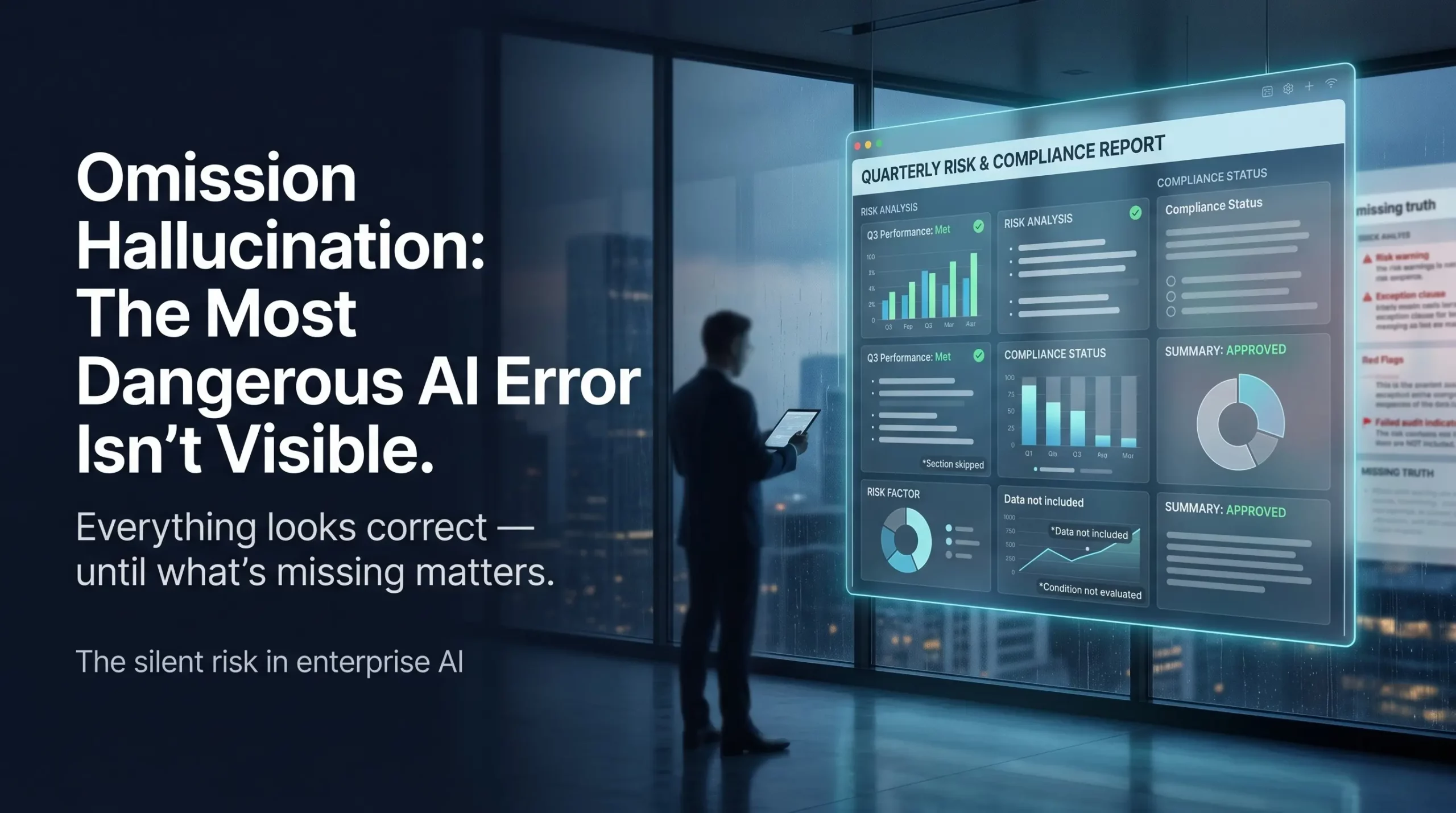
Your AI didn’t make anything up. Every sentence it produced was factually accurate. The logic held together. The tone was professional. And yet — it caused a serious problem.
That’s omission hallucination in AI. And in many ways, it’s more dangerous than the hallucination types most people already know about.
When an AI fabricates a fact, someone usually catches it. The number doesn’t match. The citation doesn’t exist. The claim sounds off. However, when an AI leaves out something critical — a caveat, a risk, an exception, a condition that changes everything — there’s nothing obviously wrong to catch. The output looks clean. The answer sounds complete. And the person reading it has no idea they’re missing the most important piece of information in the room.
That’s the nature of omission hallucination. It’s not what your AI says. It’s what your AI doesn’t say. And for enterprise teams relying on AI for decision-making, customer communication, legal review, or operational guidance, the gap between what was said and what should have been said can be enormous.
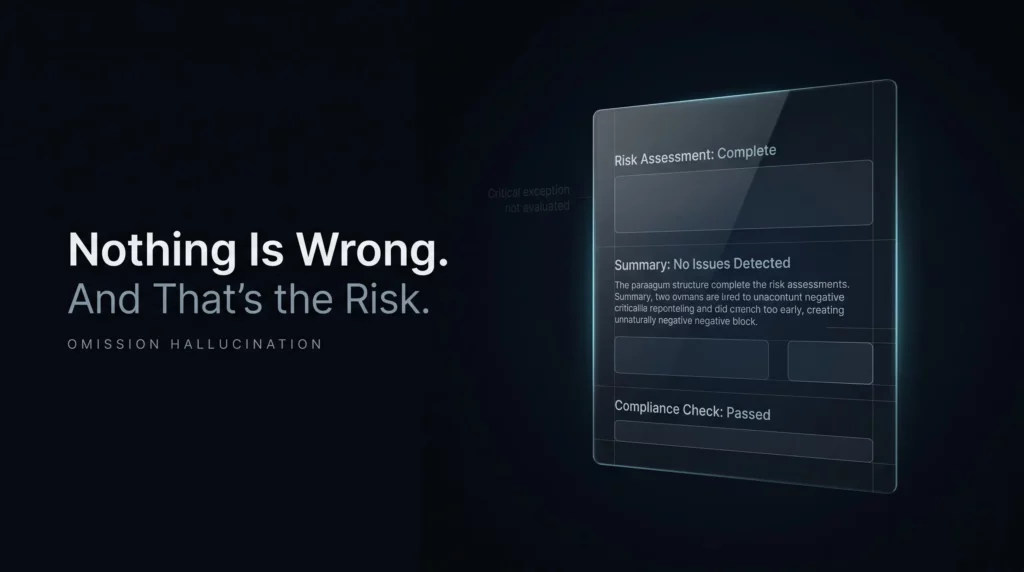
Omission hallucination in AI occurs when a language model produces a response that is technically accurate but critically incomplete — leaving out exceptions, conditions, risks, or contextual nuances that would materially change how the output is interpreted or acted upon.
Most discussions about AI hallucination focus on commission: the model invents something that doesn’t exist. Omission hallucination is the opposite failure mode. Rather than adding false information, the model removes true information — either by not including it in the first place or by failing to flag it as relevant to the query at hand.
Think about the difference this way. Suppose a user asks your AI-powered contract review tool: “Is there anything in this agreement that limits our liability?” The model scans the document and responds: “The contract includes a standard limitation of liability clause in Section 9.” That’s accurate. However, if the same contract also contains an indemnification clause in Section 14 that effectively overrides the liability limit under specific conditions — and the model doesn’t mention it — you have an omission hallucination. The user walks away thinking they’re protected. In reality, they’re exposed.
Nothing the AI said was wrong. Everything it didn’t say was catastrophic.
Fabrication leaves traces. You can fact-check a claim, verify a citation, cross-reference a statistic. Omission, on the other hand, leaves nothing. You’d have to already know what was missing in order to notice it’s gone — which means you’d already have to be the expert the AI was supposed to replace.
This is precisely what makes omission hallucination in AI such a significant enterprise risk. It operates invisibly, inside outputs that look correct on the surface. Moreover, it tends to cluster around exactly the kinds of queries where completeness matters most: risk assessments, regulatory guidance, safety protocols, financial analysis, and any situation where the exception is as important as the rule.
Understanding why omission hallucination occurs is the first step toward fixing it. The causes are structural — they’re baked into how language models are trained and evaluated.
Language models are optimized to produce helpful, coherent, concise responses. During training, shorter and more direct answers often score better than longer, more qualified ones. After all, a response that includes every caveat, exception, and edge case can feel unhelpful — like the AI is hedging rather than answering.
As a result, models develop a strong bias toward confident, streamlined answers. They’ve learned that complete-sounding responses generate better feedback than technically complete ones. The model therefore prunes its output toward what feels satisfying rather than what is genuinely comprehensive. Consequently, exceptions get dropped. Caveats get softened. The rare-but-critical edge case disappears.
This is closely related to the nuance problem we explored in The “Always” Trap: Why Your AI Ignores the Nuance — models that treat context as binary (always / never) instead of conditional (usually, except when…) are the same models most prone to omission hallucination. When nuance gets flattened, what gets lost is usually the most important qualifier in the sentence.
Even when a model is trying to be thorough, omission hallucination can still occur because of what isn’t in its context window. If the critical exception lives in a section of a document the model didn’t retrieve, in a conversation the model didn’t have access to, or in a dataset the model was never trained on — it simply cannot include what it doesn’t know.
Furthermore, in retrieval-augmented generation (RAG) systems, the quality of omission is directly tied to the quality of retrieval. If your retrieval layer surfaces the wrong chunks, the model answers correctly based on what it received — and omits everything that was in the chunks it never saw.
This intersects directly with what we described in When AI Forgets the Plot: How to Stop Context Drift Hallucinations — when models lose track of earlier context in long sessions, the information they “forget” doesn’t disappear with a visible error. It disappears silently, leaving a response that feels coherent but is missing critical grounding.
There’s a third cause that’s less discussed but equally important. In many domains — especially specialized ones like healthcare, legal, financial compliance, and advanced manufacturing — the critical exceptions are often underrepresented in training data. The general rule appears hundreds of thousands of times. The narrow but critical exception appears a few dozen times.
The model learns the rule well. However, it learns the exception poorly. So when it generates a response, the rule dominates and the exception gets left behind. Not because the model decided to omit it — but because the model simply doesn’t know it well enough to know it should be included.
Let’s be direct about what omission hallucination in AI actually costs at scale.
The most immediate cost is bad decisions made on good-looking outputs. When an executive, legal team, or operations manager receives an AI-generated summary, analysis, or recommendation, they’re implicitly trusting that the model surfaced everything material to the question. If it didn’t — if it omitted a risk, a regulation, a condition, or a constraint — the decision that follows is based on a fundamentally incomplete picture.
In lower-stakes environments, this creates inefficiency. In higher-stakes environments — regulatory submissions, contract negotiations, safety documentation, investment theses — it creates liability. And because the AI output looked clean and confident, there’s often no indication that anything was missed until the consequence arrives.
There’s also a softer but equally damaging cost: the erosion of trust in your AI-powered products. Users who discover that an AI assistant gave them an answer that omitted something important don’t just lose confidence in that one answer. They lose confidence in all future answers. Because unlike a factual error, which feels like a mistake, an omission feels like negligence.
This connects to the broader reliability challenge we explored in The Logic Trap: When AI Sounds Perfectly Reasonable — an AI that produces outputs that are logically consistent but structurally incomplete is arguably more dangerous than one that makes obvious errors, because the confidence it projects is not proportional to the completeness of what it’s saying.
In regulated industries, omission hallucination in AI is a direct compliance exposure. A drug interaction AI that answers correctly for 99% of cases but omits the critical contraindication for a specific patient profile isn’t 99% safe — it’s categorically unsafe. A financial compliance tool that accurately summarizes a regulation but omits the most recent amendment isn’t a useful tool — it’s a liability generator.
The standard in regulated environments isn’t “mostly right.” Accordingly, any AI deployment in those contexts needs to be held to a completeness standard, not just an accuracy standard. That’s a fundamentally different bar — and most enterprise AI deployments haven’t been built to meet it yet.
The first and most accessible fix for omission hallucination in AI is also the most underused: explicit completeness instructions in your system prompt.
Most system prompts tell the model what to do. Very few tell the model what “complete” means. As a result, the model fills that gap with its own definition — which, as we’ve established, skews toward concise and confident rather than comprehensive and cautious.
Completeness prompting changes that by building explicit checkpoints into the model’s instructions. For example:
“When answering any question about contract terms, risk, or compliance: always include exceptions, conditions, and edge cases that would affect the answer. If there are scenarios under which the answer changes, state them explicitly. Do not summarize unless you have confirmed that no material condition has been omitted.”
This kind of instruction does three things simultaneously. First, it redefines “done” for the model in this specific context. Second, it trains the model to look for exceptions rather than prune them. Third, it creates a natural audit trail — if the model’s output doesn’t include caveats, it’s a signal that the model either found none or didn’t look. Either way, you know to investigate.
For specialized domains, completeness prompting can go further — explicitly listing the categories of omission that matter most in that context.
For instance, in a legal review context: “Always flag: conflicting clauses, override conditions, jurisdictional variations, and time-limited provisions.” In a healthcare context: “Always flag: contraindications, dosage edge cases, population-specific risks, and off-label use considerations.”
The Ai Ranking team has built domain-specific completeness frameworks directly into enterprise AI deployment stacks — because generic completeness prompting only gets you so far. Domain expertise has to be encoded into the prompt architecture itself. You can explore how that works at airanking.io.
Even the best completeness prompting isn’t sufficient on its own. That’s why the second fix for omission hallucination in AI is structural: a validation layer that evaluates outputs against a completeness checklist before they reach the user.
Output validation for omission hallucination works differently from factual validation. You’re not checking whether a claim is true — you’re checking whether required categories of information are present.
In practice, this means building a secondary evaluation step into your AI pipeline. After the primary model generates its response, a validation layer checks the output against a structured completeness schema. Depending on your domain, that schema might ask: “Does this output address exceptions? Does it flag conditions? Does it include a risk qualifier where one is appropriate? Does it reference the most recent version of the relevant guideline?”
If the answer to any mandatory check is no, the output is either returned to the primary model for revision or escalated to a human reviewer before delivery.
For high-stakes decisions, automated validation alone isn’t enough. Furthermore, building a human review checkpoint specifically for completeness — separate from the fact-checking review — is one of the highest-leverage investments an enterprise can make in AI reliability.
The key insight: the humans in this loop don’t need to be AI experts. They need to be domain experts who know what a complete answer in their field looks like. Give them a structured checklist rather than asking them to evaluate the full output, and the review becomes fast, consistent, and scalable. The Ai Ranking platform provides structured completeness review frameworks for exactly this kind of human-in-the-loop integration at airanking.io/platform.
For teams using RAG-based AI systems, omission hallucination is often fundamentally a retrieval problem. The model can’t include what it doesn’t receive. Therefore, the third fix isn’t about prompting or validation — it’s about improving the pipeline that feeds the model its context.
Most RAG implementations optimize for relevance — surfacing the chunks most likely to contain the answer. However, relevance-optimized retrieval systematically deprioritizes exception content. An exception clause, a contraindication note, or a regulatory amendment is, by definition, less frequently queried than the main rule. As a result, it tends to score lower in relevance rankings.
Fixing this requires retrieval architectures that optimize explicitly for completeness, not just relevance. In practice, that means supplementing semantic search with structured retrieval rules: “For any query about X, always retrieve chunks tagged as [exception], [override], [amendment], or [condition].” The main answer and the critical exception get surfaced together, rather than the main answer winning the relevance race alone.
This approach requires investment in your knowledge base architecture — specifically, tagging content at the chunk level with metadata that signals its type. Main rule. Exception. Condition. Caveat. Override. Once that tagging infrastructure exists, your retrieval layer can be trained to always pull paired content: the rule and its exception together.
It sounds like an infrastructure investment. In reality, however, it’s the single highest-leverage change you can make to a RAG system specifically to reduce omission hallucination. Ai Ranking provides a full implementation guide for completeness-optimized retrieval architectures at airanking.io/resources.
If you’re reading this and recognizing your own systems in these descriptions, that’s actually a good sign. It means you’re operating at a level of AI maturity where you’re asking the right questions — not just “is our AI accurate?” but “is our AI complete?”
Most enterprise AI evaluations are built around accuracy metrics. Precision. Recall. F1 scores. These metrics tell you whether what the model said was correct. However, none of them tell you whether what the model said was sufficient.
Completeness is a fundamentally different quality dimension — and building it into your evaluation framework is one of the most important shifts an AI-mature organization can make. It requires domain expertise, structured evaluation, and a willingness to hold AI outputs to the same standard you’d hold a human expert: not just “were they right?” but “did they tell me everything I needed to know?”
Omission hallucination in AI doesn’t just create individual bad outputs. At scale, it creates systematic gaps in organizational knowledge. If your AI systems are consistently producing answers that omit a specific category of exception, every decision downstream of those systems is missing the same piece of information. Over time, that systematic omission becomes embedded in your operational assumptions — until the exception finally occurs in the real world, and nobody has a process for handling it.
The three fixes — completeness prompting, output validation layers, and retrieval architecture improvement — work together to address this at every layer of your AI stack. Each one closes a different vector through which omissions enter your outputs. Together, they shift your AI systems from impressive-sounding to genuinely reliable.
Here’s what most AI vendors won’t tell you: an AI that sounds complete is not the same as an AI that is complete. The gap between those two things — the information that was true, relevant, and critical but simply wasn’t included — is omission hallucination in AI. And in enterprise contexts, that gap doesn’t just create inconvenience. It creates risk.
The good news is that omission hallucination is fixable. Unlike hallucination types rooted in training data fabrication, omission is primarily an architectural and configuration problem. You can address it at the prompt level, at the pipeline level, and at the retrieval level — and each fix compounds the others.
The real question isn’t whether your AI is hallucinating by omission right now. It almost certainly is. The question is whether you’ve built the systems to catch it before it costs you.
How can you supercharge your business with bespoke solutions and products.